Ever seen a charge on your account that you did not recognize and felt your stomach drop?
That feeling is not just panic. It is your brain doing its own kind of threat detection. You may not know the full picture, but you know something is off. And in the world of cybersecurity, there is a name for that kind of informed awareness: Cyber Threat Intelligence.
Cyber threat intelligence, or threat intel, is the process of collecting, analyzing, and applying information about potential or active threats. It helps people and organizations make smarter decisions about security before an attack causes real damage.
So what does cyber threat intelligence really do?
It gives context. Not just that a threat exists, but what kind it is, who it is targeting, and how to respond.
There are different types of threat intelligence:
- Strategic gives the big picture, like trends and motivations behind attacks
- Tactical shows how threats work, like tools and methods
- Operational gives detail on specific campaigns or timing
- Technical flags indicators like bad IP addresses or leaked credentials
These are the kinds of signals that power the alerts you sometimes get from apps, email services, or even your bank. The ones that say: your password was found in a breach or your email may have been involved in a data leak. That is not spam. That is cyber threat intelligence in action.
But it only helps if we know how to respond.
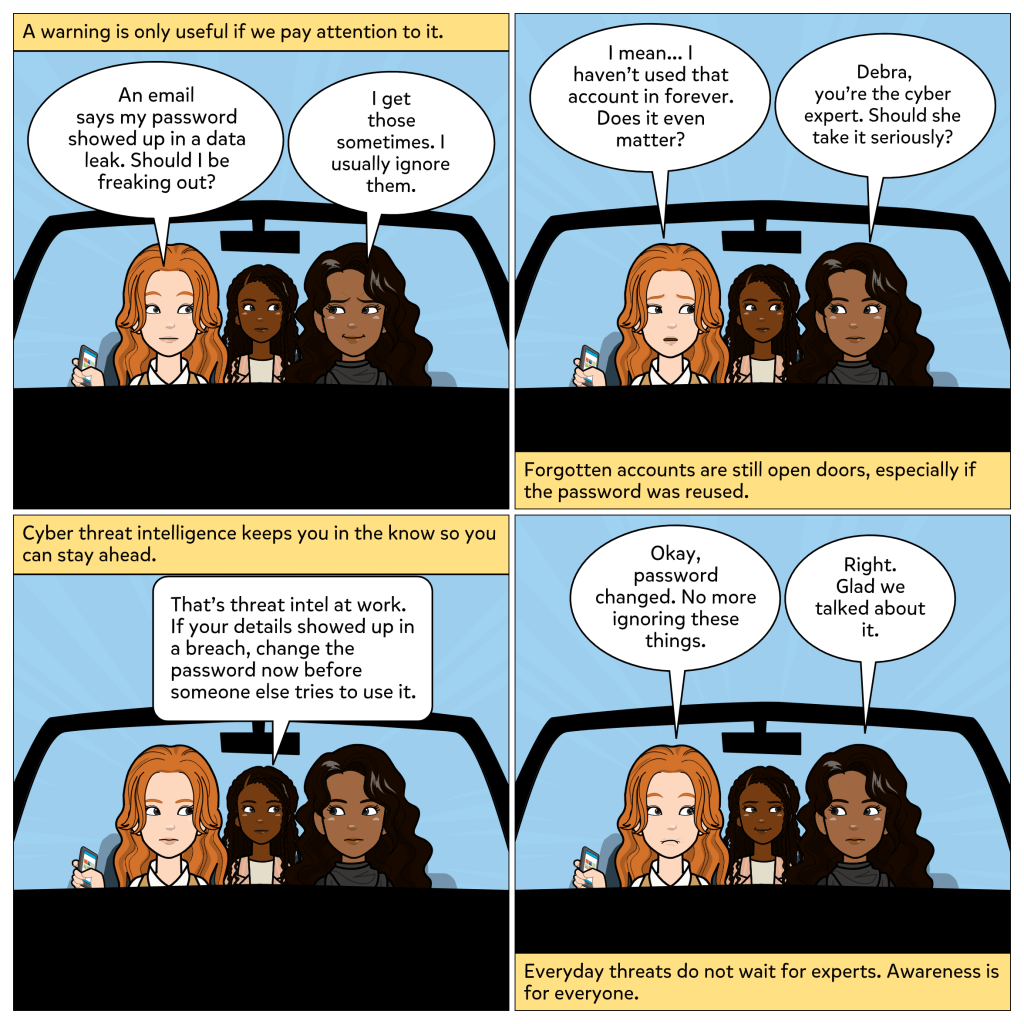
A real life moment: the comic
In this week’s comic, Michelle and Brittany are chatting in the car. Brittany just got an alert that her password was found in a data leak. She is not sure if it is serious. Michelle admits she usually ignores those messages.
They turn to Debra, who reminds them that this is exactly what threat intel is for. Someone flagged that Brittany’s info was exposed. That is a signal worth acting on. Because if that password was reused, even on an old account, it could still be a door into more valuable systems.
The conversation is short. But it turns awareness into action. A password gets changed. A habit gets rethought.
That is cyber threat intelligence working as it should. It’s not just for analysts and security teams, but for anyone with an email address, a bank account, or a digital footprint.
Everyday threats do not wait for experts
If a system or service you use tells you something might be wrong, do not ignore it. You do not need to panic, but you do need to pay attention.
That is the power of threat intel. It helps you decide what is noise and what needs your next move.
Stay aware. Stay curious. And stay ready.
Have you ever ignored an alert and regretted it later? Or followed one and caught a problem early? I would love to hear what stood out to you.
Thanks for reading. If you are new here, I hope you will subscribe.
Cyber With Debra is all about making security real and relatable, one everyday moment at a time. ✨
 Cyber With Debra!
Leave a comment