• Security issues do not all carry the same weight. Some problems are inconvenient. Others can threaten the entire organization.

    In this week’s comic, Joe mentions two new tickets: a website bug and a database exposure. Both are security concerns, but the team cannot address both immediately. Maria wonders if they should be treated as equally urgent.

    Debra explains that risk assessment helps organizations decide what to prioritize. It weighs likelihood and impact. One issue might slow operations down. The other could shut them down completely.

    Risk is not guessed. It is evaluated.

    What risk assessment really does
    Risk assessment is the process of identifying potential threats, evaluating how likely they are to occur, and determining the impact they would have if they did.

    Organizations use risk assessment to:

    • Identify vulnerabilities and threats
    • Estimate likelihood of exploitation
    • Measure potential impact on operations, data, and reputation
    • Prioritize remediation efforts
    • Decide whether to mitigate, transfer, accept, or avoid risk

    Without assessment, teams may waste time fixing minor issues while serious exposures remain unresolved.

    Risk assessment provides structure to decision making.

    Why it matters
    Security resources are limited. Time, personnel, and budget cannot address everything at once.

    If every issue is treated as equally urgent, teams lose focus. Critical risks may not receive the attention they require.

    By evaluating both likelihood and impact, organizations can focus on what could cause the most harm. This ensures that security efforts align with business priorities.

    Risk assessment turns reaction into strategy.

    Everyday takeaway
    Not every warning deserves the same response.

    In cybersecurity and in daily life, the most effective decisions come from understanding consequences, not just reacting to urgency.

    Security is not about fixing everything. It is about fixing what could hurt the most.

    Thank you for reading. I hope you are subscribed. What factors do you think organizations should consider most when evaluating risk? ⚖️
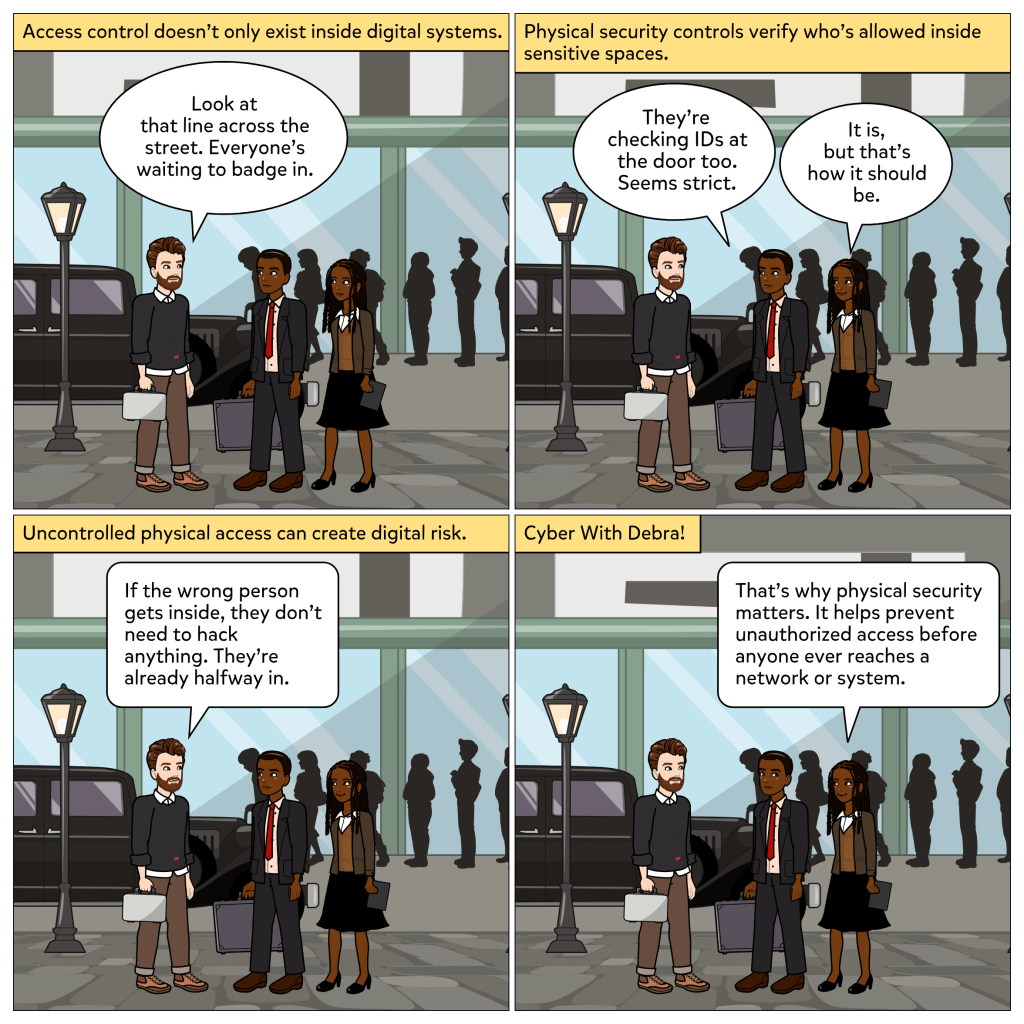
  • Access control does not only exist inside digital systems. Sometimes, the first layer of cybersecurity starts at a building entrance.

    In this week’s comic, Jake notices a long line across the street. Employees are waiting to badge in before entering the office. Ray points out that IDs are being checked as well. It seems strict at first glance, but Debra reminds them that it is exactly how it should be.

    Later, the conversation shifts. If the wrong person gains physical access, they do not need to break through firewalls or guess passwords. They are already halfway in.

    Physical security is not separate from cybersecurity. It supports it.

    What physical security controls really do
    Physical security controls are safeguards designed to protect buildings, equipment, and sensitive areas from unauthorized access.

    These controls include:

    • Badge access systems
    • ID verification
    • Security guards
    • Locked server rooms
    • Surveillance cameras
    • Visitor logs

    They help ensure that only authorized individuals can access certain spaces. That protection reduces the risk of tampering, theft, device compromise, or insider misuse.

    Security is layered. Physical controls are one of the first layers.

    Why it matters
    When people think about cybersecurity, they often imagine malware, phishing emails, or hackers behind screens.
    But many incidents start much earlier.

    If someone can walk into a restricted space, plug into a network port, access an unattended workstation, or remove a device, they may bypass technical defenses entirely.
    Physical access can quickly become digital compromise.

    That is why access control is about more than doors. It is about protecting systems before someone ever reaches them.

    Everyday takeaway
    Security measures sometimes feel inconvenient.
    Waiting in line. Showing an ID. Badging in. Signing visitor logs.
    But those small actions protect something much bigger.

    Cybersecurity is not only about what happens online. It begins with controlling who can physically reach your systems in the first place.

    Strong security starts at the door.

    Thank you for reading. I hope you are subscribed. What physical security controls have you seen that made you think twice about how organizations protect their systems? 🏢

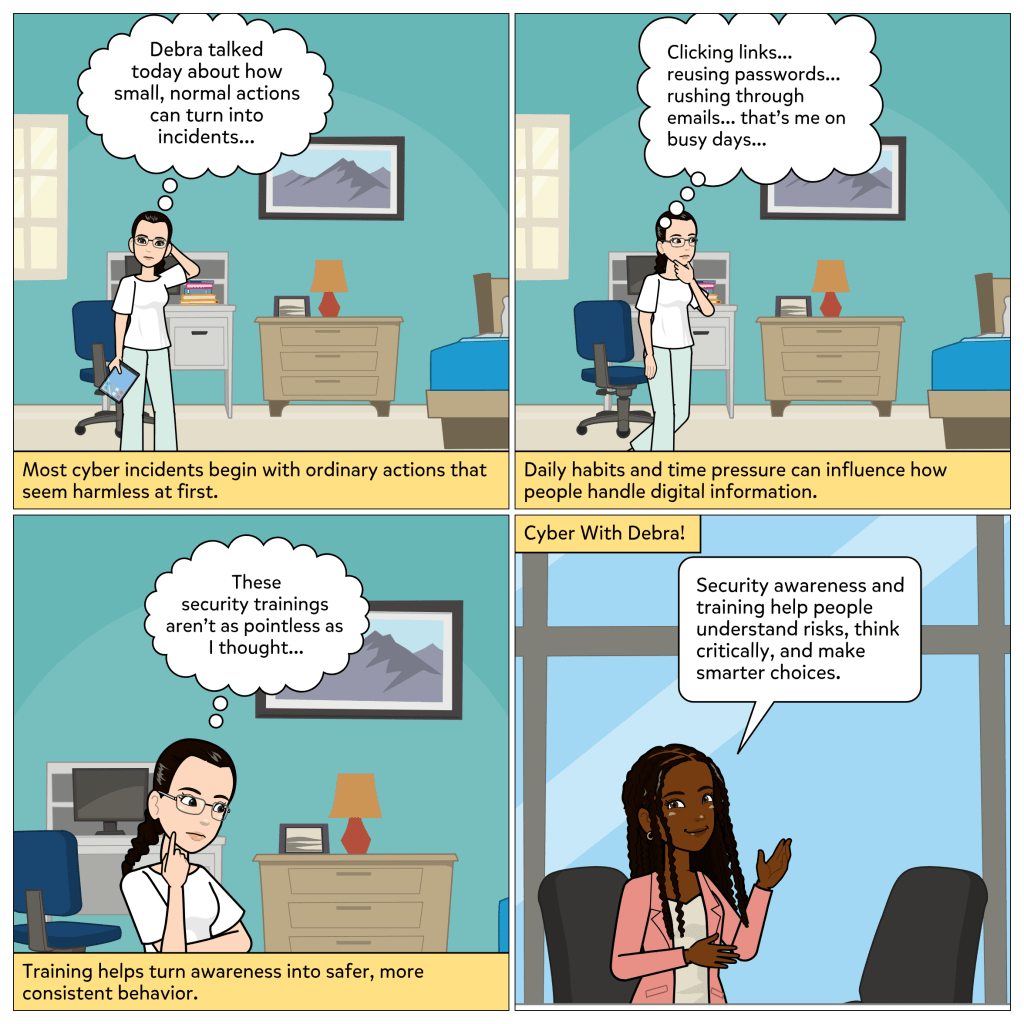
  • Security incidents rarely start with something dramatic. Most of the time, they begin with small, normal actions that do not feel risky in the moment.

    Clicking a link while multitasking.
    Reusing a password because it is convenient.
    Rushing through emails on a busy day.
    These are everyday habits, and they are exactly why security awareness and training matter.

    In this week’s comic, Maria reflects on a security training provided earlier in the day. Debra had explained how ordinary actions can turn into security incidents. Later that evening, as Maria goes about her routine, those ideas start to resurface. She recognizes her own habits and realizes that the training was not pointless after all. It helped her pause, think, and connect the dots.

    That pause is where awareness begins to work.

    What security awareness and training really do
    Security awareness is not about memorizing rules or passing quizzes. It is about helping people understand how risk shows up in everyday situations.

    Effective security awareness and training help organizations by:

    • Teaching people how attackers take advantage of routine behavior
    • Helping employees recognize warning signs before incidents occur
    • Encouraging thoughtful decision-making under time pressure
    • Reducing mistakes caused by assumptions or familiarity
    • Reinforcing consistent, safer habits over time

    Training does not eliminate risk. It reduces the likelihood that small actions turn into larger problems.

    Why it matters
    Many security incidents do not happen because someone intended harm. They happen because someone did not recognize risk in the moment.

    Attackers rely on distraction, urgency, and familiarity. They count on people being busy, tired, or rushed. When awareness is low, those tactics work more easily. When awareness is present, people slow down, question what they see, and make better choices.

    Security awareness shifts security from being a technical issue to a shared responsibility.

    Everyday takeaway
    Security awareness is not about being perfect. It is about being mindful.

    The goal is not to catch every threat. The goal is to recognize when something deserves a second look. Training plants that awareness so it shows up later, even outside of work hours, in quiet moments when decisions are being made.

    That is when security awareness is doing its job.

    Thank you for reading. I hope you are subscribed. Let me know in the comments what everyday habits have made you stop and think twice lately. 🧠

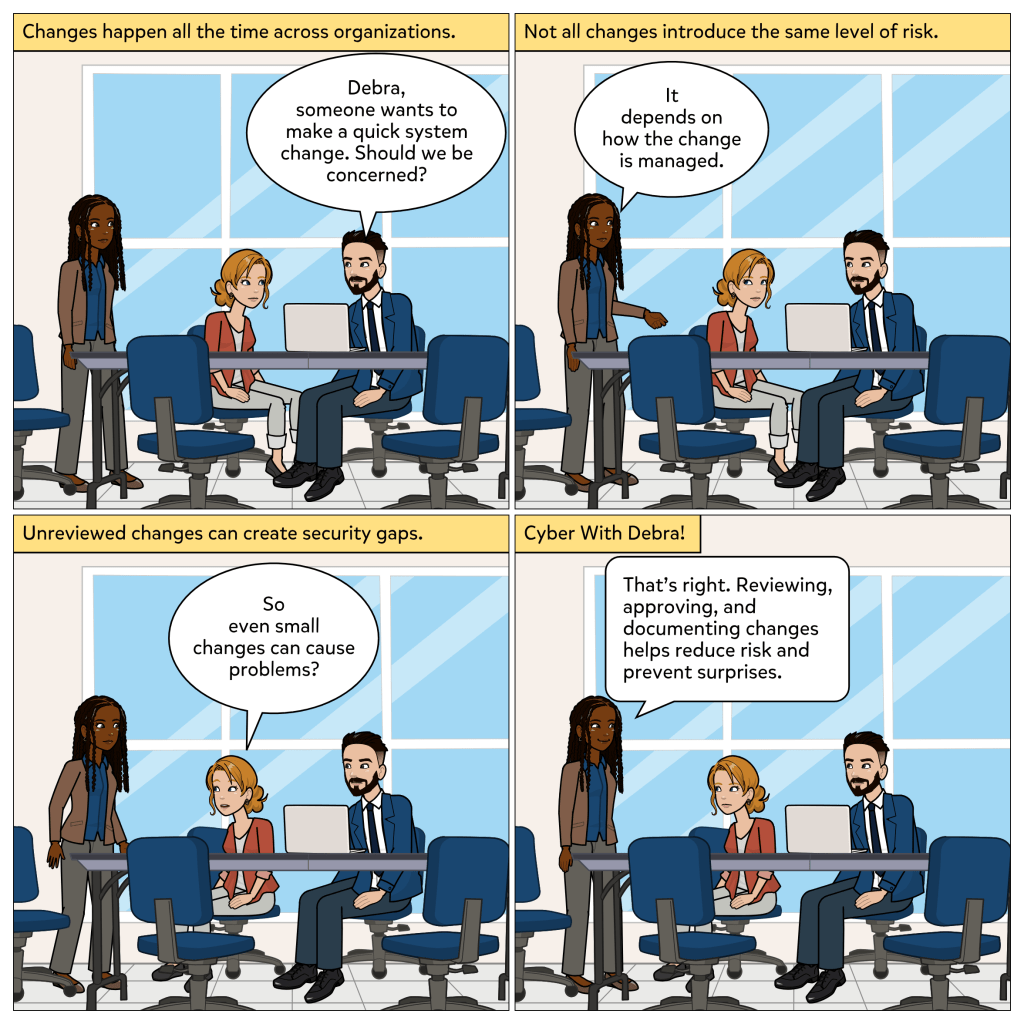
  • Changes happen constantly across organizations. Systems are updated, configurations are adjusted, and new tools are introduced to support business needs. While change is necessary, not every change carries the same level of risk.

    That is why how a change is handled matters just as much as the change itself.

    In this week’s comic, someone approaches Debra with a question about making a quick system change. The concern is not about whether change is bad, but whether it has been reviewed and managed properly. Debra explains that risk depends on how the change is handled, not simply the fact that a change is happening.

    This is where change management comes in.

    What change management means
    Change management is the process of reviewing, approving, and documenting changes before they are made to systems or environments. The goal is to reduce unintended consequences and avoid introducing security gaps.

    When changes are made without oversight, even small adjustments can cause issues. A configuration tweak, a permission change, or a software update can create vulnerabilities if no one is tracking what changed and why.

    With proper change management, organizations can:

    • Understand what is being changed and the potential impact
    • Ensure changes are approved by the right people
    • Document changes so they can be reviewed or reversed if needed
    • Reduce unexpected outages or security exposures

    Change management does not slow work down. It helps teams stay in control.

    Why it matters
    Many security incidents are not caused by attackers finding brand new flaws. They start with changes that were never reviewed or documented. An untracked system change can open access, disable protections, or break monitoring without anyone realizing it.

    When changes are reviewed and recorded, teams can trace issues back to their source, respond faster, and prevent repeat problems. This is especially important in environments that handle sensitive data or support critical services.

    Security depends on consistency. Change management helps maintain that consistency even as systems evolve.

    Everyday takeaway
    Think of change management like making adjustments to your home. You would not remove a door, change the locks, or rewire something without thinking through the impact. You would want to know what changed and why in case something goes wrong later.

    Systems work the same way. Reviewing and documenting changes helps prevent surprises and keeps environments stable and secure.

    Thank you for reading.
    Change is constant, but how it’s managed makes all the difference.
    Let me know what kinds of changes you see most often in your environment. 🧭

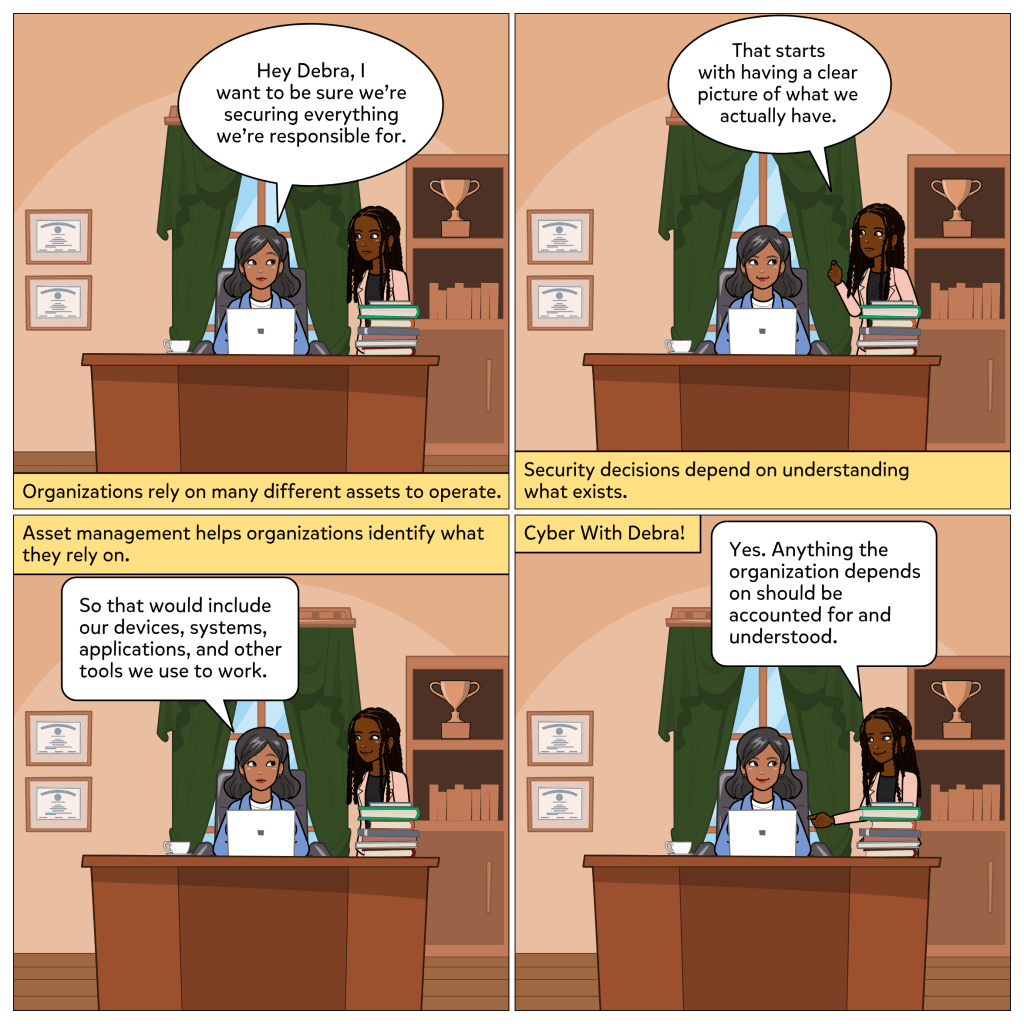
  • Security does not start with tools or controls. It starts with knowing what you are actually responsible for protecting.

    Many organizations rely on a wide range of devices, systems, applications, and services to operate. Over time, it becomes easy to lose track of what exists, who owns it, and how critical it is to daily operations. When that happens, security decisions are often made with incomplete information.

    Asset management helps close that gap by giving organizations a clear understanding of what they rely on and where security efforts should be focused.

    In this week’s comic, Sabrina wants to make sure the organization is securing everything it is responsible for. Debra explains that the first step is having a clear picture of what actually exists. Together, they talk through how devices, systems, applications, and tools all count as assets. Debra reinforces that anything the organization depends on should be accounted for and understood.

    What asset management does
    Asset management is the practice of identifying, tracking, and maintaining an inventory of organizational assets. These assets can include hardware, software, data, and supporting systems.

    With effective asset management, organizations can:
    • Understand what devices and systems are in use
    • Assign ownership and responsibility
    • Identify which assets are most critical
    • Apply security controls consistently
    • Reduce blind spots that attackers can exploit

    You cannot protect what you do not know exists.

    Why it matters
    Many security incidents begin with forgotten or unmanaged assets. An old server, an unused application, or an untracked device can become an easy target because it is not monitored or updated.

    In industries like healthcare, finance, and public service, unmanaged assets increase the risk of data exposure, downtime, and compliance issues. Asset management helps ensure security decisions are based on reality, not assumptions.

    When organizations know what they have, they can make smarter choices about protection, monitoring, and response.

    Everyday takeaway
    Think about your own responsibilities. It is hard to keep something safe if you are not aware of it or do not understand its importance.

    Cybersecurity works the same way. Visibility creates accountability, and accountability enables protection.
    Knowing what you are responsible for is the foundation of good security.

    Thank you for reading. I hope you have subscribed. Let me know in the comments how organizations can improve visibility into the systems they rely on most. 📋

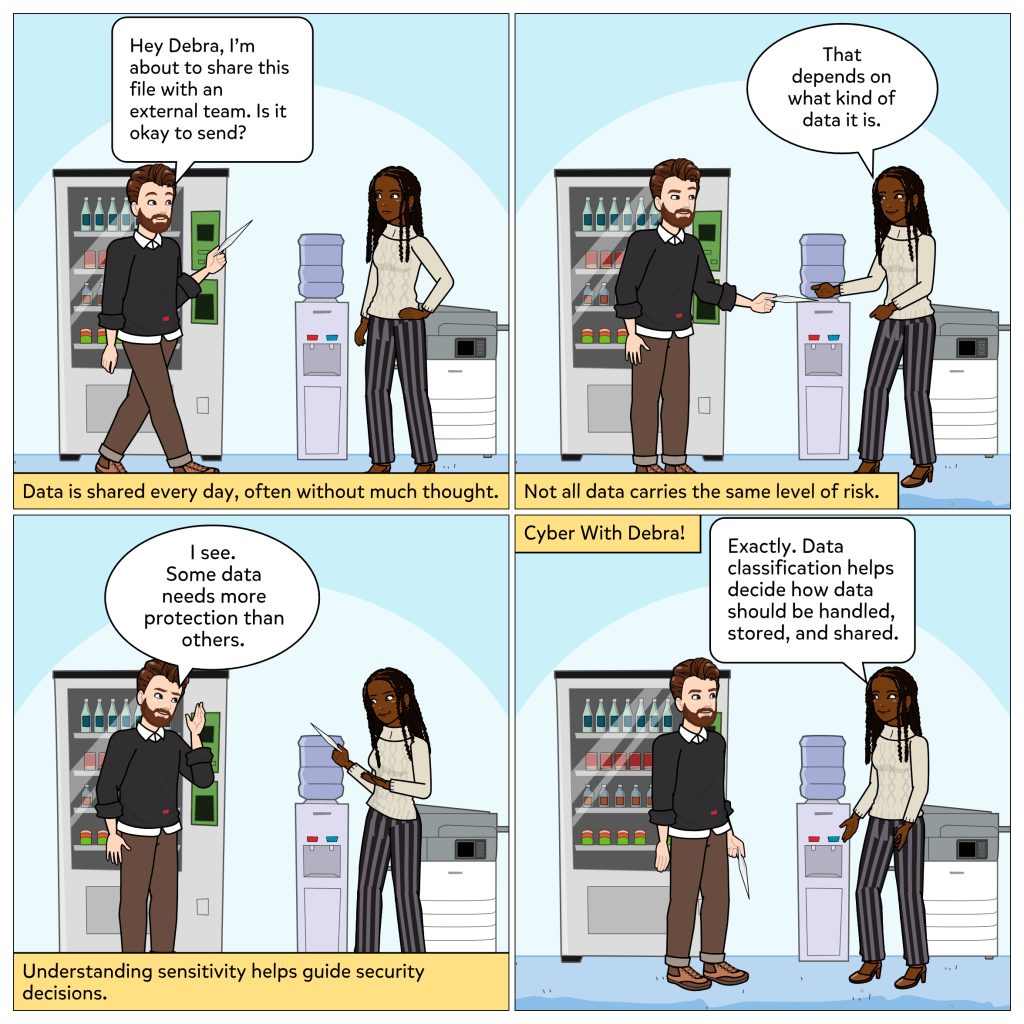
  • Data is shared every day, often without much thought. Files are emailed, uploaded, and forwarded as part of normal work. But not all data should be treated the same way, and that is where data classification comes in.

    Data classification is the process of identifying how sensitive information is and deciding how it should be handled, stored, and shared. Some data can be shared freely. Other data requires extra care, tighter controls, or approval before it leaves an organization.

    In this week’s comic, Jake mentions that he is about to share a file with an external team and wants to know if it is okay to send. Debra explains that the answer depends on what kind of data it is. Jake realizes that some data needs more protection than others. Debra ties it together by explaining that data classification helps guide those decisions so information is handled appropriately.

    What data classification does
    Data classification creates clarity around information and reduces guesswork.

    With data classification, organizations can:
    • Identify sensitive information before it is shared
    • Apply the right level of protection to different types of data
    • Reduce the risk of accidental exposure
    • Support compliance with privacy and security requirements
    • Help employees make better decisions when handling information

    When people understand what kind of data they are working with, they are less likely to overshare or make assumptions.

    Why it matters
    Many data incidents do not start with an attack. They start with a simple mistake. Someone shares a file they thought was harmless, only to realize later that it contained sensitive information.

    Data classification helps prevent those moments by setting expectations ahead of time. It provides a shared understanding of what data is public, internal, confidential, or restricted. When that understanding is in place, security becomes part of everyday work rather than an afterthought.

    In environments like healthcare, finance, and education, data classification is especially important because the information being handled directly impacts people’s lives, privacy, and trust.

    Everyday takeaway
    Think of data classification like sorting important documents at home. Some papers can sit on your desk. Others belong in a locked drawer or safe. You do not treat everything the same because not everything carries the same risk.

    Security works the same way. When you know what kind of data you are handling, you know how careful you need to be.

    Thank you for reading. I hope you have subscribed. Let me know in the comments how your organization decides what data can be shared and what should stay protected. 📁

  • Modern organizations rarely operate alone. Vendors, partners, and service providers often need access to systems, data, or networks to get work done. While these relationships help businesses move faster, they also introduce new security risks that cannot be ignored.

    Third-party risk management focuses on understanding and reducing the risks that come from working with external parties. Even when internal security controls are strong, a vendor with weak security practices can become an unexpected entry point for attackers.

    In this week’s comic, Maria mentions that the organization is bringing on a new vendor who will need access to some internal systems. Debra explains that this is exactly where third party risk management comes into play. Maria asks whether a vendor can still introduce risk even if internal systems are secure. Debra confirms that risk does not stop at an organization’s boundary and that external access must be assessed carefully.

    What third-party risk management does
    Third-party risk management is the process of identifying, assessing, and reducing risks associated with vendors, partners, and suppliers.

    With third-party risk management, organizations can:

    • Evaluate vendor security practices before granting access
    • Limit access to only what a third party truly needs
    • Monitor vendor activity over time
    • Reduce the likelihood of breaches caused by external relationships
    • Maintain accountability across the entire business ecosystem

    It helps ensure that external access does not quietly become internal exposure.

    Why it matters
    Many major security incidents begin outside the organization. A compromised vendor account, a misconfigured third-party system, or weak vendor security controls can all lead to serious consequences. Attackers often look for the easiest path in, and that path is sometimes through a trusted third party.

    In industries like healthcare, finance, and technology, third-party risk management is essential for protecting sensitive data, meeting compliance requirements, and maintaining trust.

    Security is no longer only about what happens inside your environment. It is also about who you allow in and how closely that access is managed.

    Everyday takeaway
    Think of third-party access like giving someone a spare key to your home. You would want to know who they are, what they need access to, and how long they will have it. You would also want to be sure that key cannot be misused.

    Cybersecurity works the same way. Third-party risk management helps organizations stay aware, stay prepared, and stay protected even beyond their own walls.

    Thank you for reading. I hope you have subscribed. Let me know in the comments how your organization evaluates vendor security. 🤝

  • A Year-End Reflection from Cyber With Debra.

    As the year comes to a close, I have shared many stories through Cyber With Debra. Stories about preparation, protection, response, and restoration. But Christmas reminds us that long before cybersecurity existed, God was already teaching humanity these same principles through redemption.

    The story of Christmas did not begin in the New Testament. It began with prophecy.

    Prophecy and Preparation
    From the beginning, Scripture pointed forward to salvation.

    Genesis 3:15 promised that redemption would come after the fall.
    Isaiah 7:14 spoke of a child born as a sign.
    Micah 5:2 identified Bethlehem as the place of His birth.
    Isaiah 9:6 revealed who He would be, Wonderful Counselor, Mighty God, Everlasting Father, Prince of Peace.
    Isaiah 53 showed what salvation would cost, suffering, sacrifice, and death.

    These were not scattered guesses. They were intentional signals. They prepared the way.

    In cybersecurity, we do not wait for an incident to understand what matters. We study patterns. We look for warnings. We prepare before failure because what we protect has value.

    God did the same. Christmas was not a reaction. It was a plan fulfilled.

    Fulfillment and Salvation
    Jesus came not only to be born, but to die.
    The manger points to the cross.
    The New Testament makes this clear.

    Ephesians 2:19 tells us that through Christ, we are no longer strangers, but members of God’s household.
    Romans 5:8 shows us that while we were still sinners, Christ died for us.
    John 3:16 reminds us why He came, because God so loved the world.

    This is the real story of Christmas.
    The Son of God entered a broken world to restore it.
    Salvation is not symbolic. It is necessary.

    In cybersecurity, recovery restores systems after damage.
    In the gospel, salvation restores humanity’s relationship with God.

    Protection Is Rooted in Value
    We protect what matters.
    We secure systems because data has value. We prepare defenses because people and operations matter.

    God sent His only Son because humanity mattered.
    Christmas tells us that protection begins with love, preparation, and purpose. It tells us that restoration was always the goal.

    Closing the Year
    As this year ends, I am grateful for every lesson shared through Cyber With Debra. But more than anything, I am grateful for the truth that anchors it all.

    Jesus came.
    The promise was kept.
    Salvation was accomplished.
    That is the story Christmas tells.
    That is the hope we carry into the new year.

    Merry Christmas. 🎄 
    See you in the new year! ✨

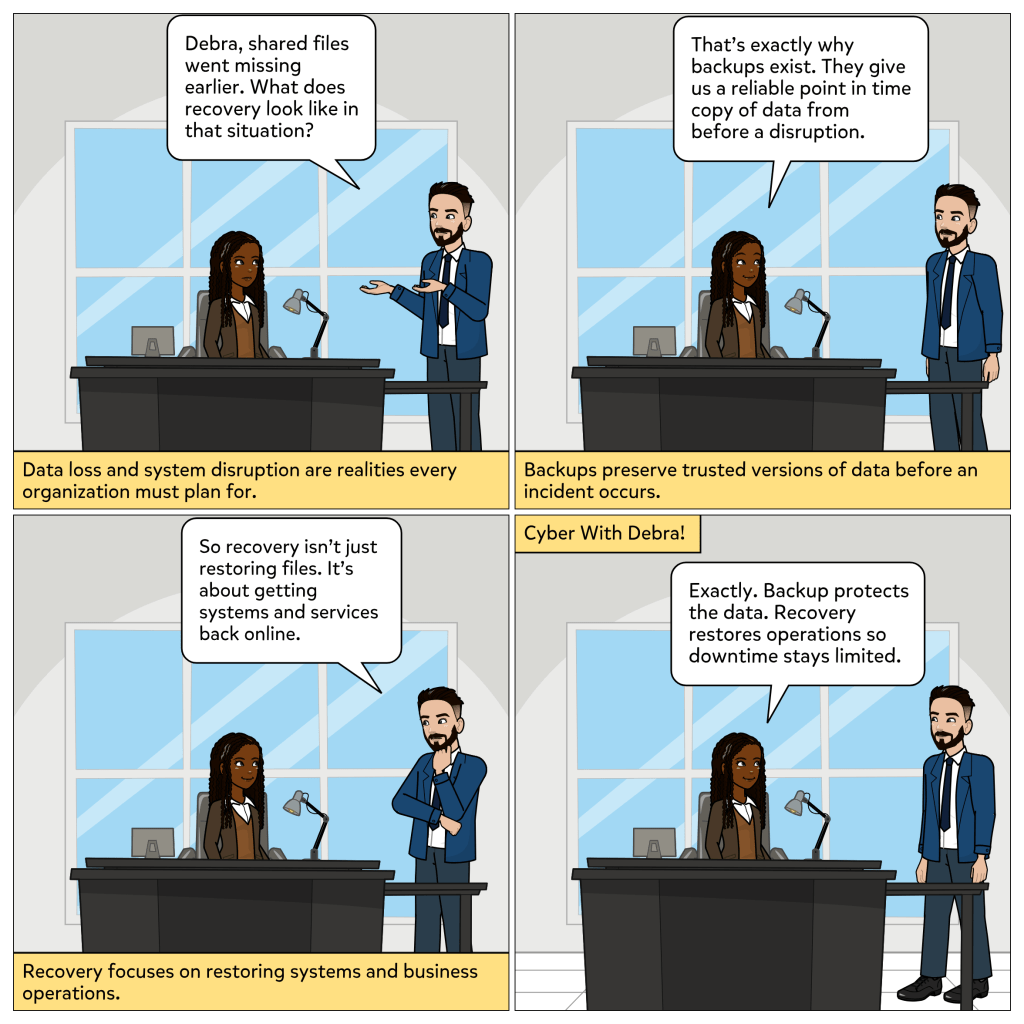
  • When people think about backups, they often picture a safety net. Something you set up once and hope you never need. But in the real world, backups and recovery are not the same thing, and understanding the difference matters more than most people realize.

    In this comic, Joe walks into Debra’s office with a real concern. Shared files went missing earlier, and he wants to know what recovery actually looks like in that situation. It is a familiar moment in many organizations, especially in environments where data is constantly being created, edited, and shared.

    What this means
    Backups exist to preserve trusted versions of data. They give organizations a reliable point in time copy from before something went wrong, whether that was accidental deletion, system failure, or a security incident.

    Recovery is what happens next. It is the process of restoring files, systems, and services so people can get back to work. Recovery is not only about bringing data back. It is about making systems usable again, reconnecting services, and minimizing disruption to daily operations.

    That distinction is important. A backup that cannot be restored quickly or correctly does not help when systems are down and work has stopped.

    Why it matters
    Data loss and system disruption are not rare events. They are realities every organization must plan for, especially in healthcare, finance, and other critical environments where downtime can have serious consequences.

    Effective backup and recovery planning helps limit how long systems are unavailable, reduces operational stress, and supports business continuity. It also plays a key role in incident response, giving teams a way to recover safely without relying on compromised or corrupted data.

    Recovery planning forces organizations to think beyond saving data and focus on how quickly and reliably they can return to normal operations.

    Everyday takeaway
    Backups protect the data.

    Recovery restores the business.

    Both are needed, and neither should be treated as an afterthought.

    Thanks for reading. If this series has been helpful, feel free to share it with someone who works with systems, data, or operations. 🗂️

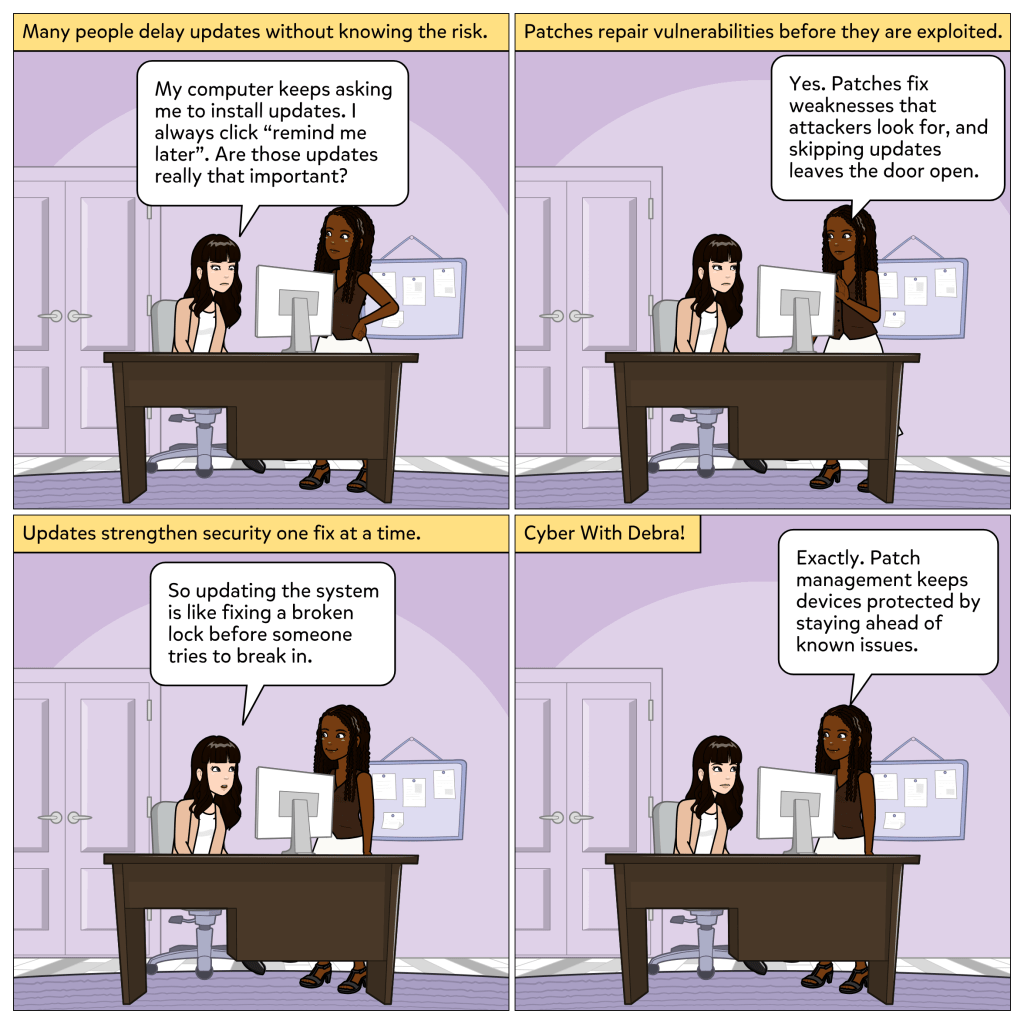
  • Software updates appear often, but many people click remind me later without a second thought. What seems like a small delay can create a real security risk. Updates exist for a reason, and one of the most important reasons is patching vulnerabilities before attackers find them.

    Patch management is the process of keeping systems updated with the latest fixes. These fixes, called patches, repair weaknesses that could otherwise be used to break into a device or application.

    In this week’s comic, Maria mentions that she often ignores update prompts. Debra explains that patches close security gaps that attackers look for, and delaying updates leaves the door open. Maria compares it to fixing a broken lock before someone tries to break in. Debra reminds her that patch management keeps devices protected by staying ahead of known issues.

    What patch management does
    Patch management is more than installing updates. It is a routine that ensures systems stay healthy, secure, and ready for use.

    With patch management, organizations can:

    Fix vulnerabilities before attackers find them
    Improve stability by repairing software bugs
    Stay compliant with security and privacy requirements
    Reduce risk by keeping all systems aligned with current protections
    Minimize downtime by preventing issues that could grow into larger problems

    A device with outdated software is easier to compromise. A device with current patches is much harder to attack.

    Why it matters
    Many cyber attacks begin with something simple: a known vulnerability that was never patched. Attackers actively scan the internet for systems running old versions of software because they already know how to break into them. Every unpatched device becomes an easy entry point.

    In industries like healthcare, finance, and public service, keeping systems updated is not just a best practice. It is essential for protecting sensitive data and maintaining trust.

    Everyday takeaway
    Think of patching like repairing things in your home. If you discover a weak spot in a window frame or a loose lock on a door, you fix it before someone notices. The longer you wait, the more opportunity you give for something to go wrong.

    Security works the same way. Regular updates remove weaknesses and keep systems safe.

    Thank you for reading. I hope you have subscribed. Let me know in the comments how often you update your devices and apps. 🔄