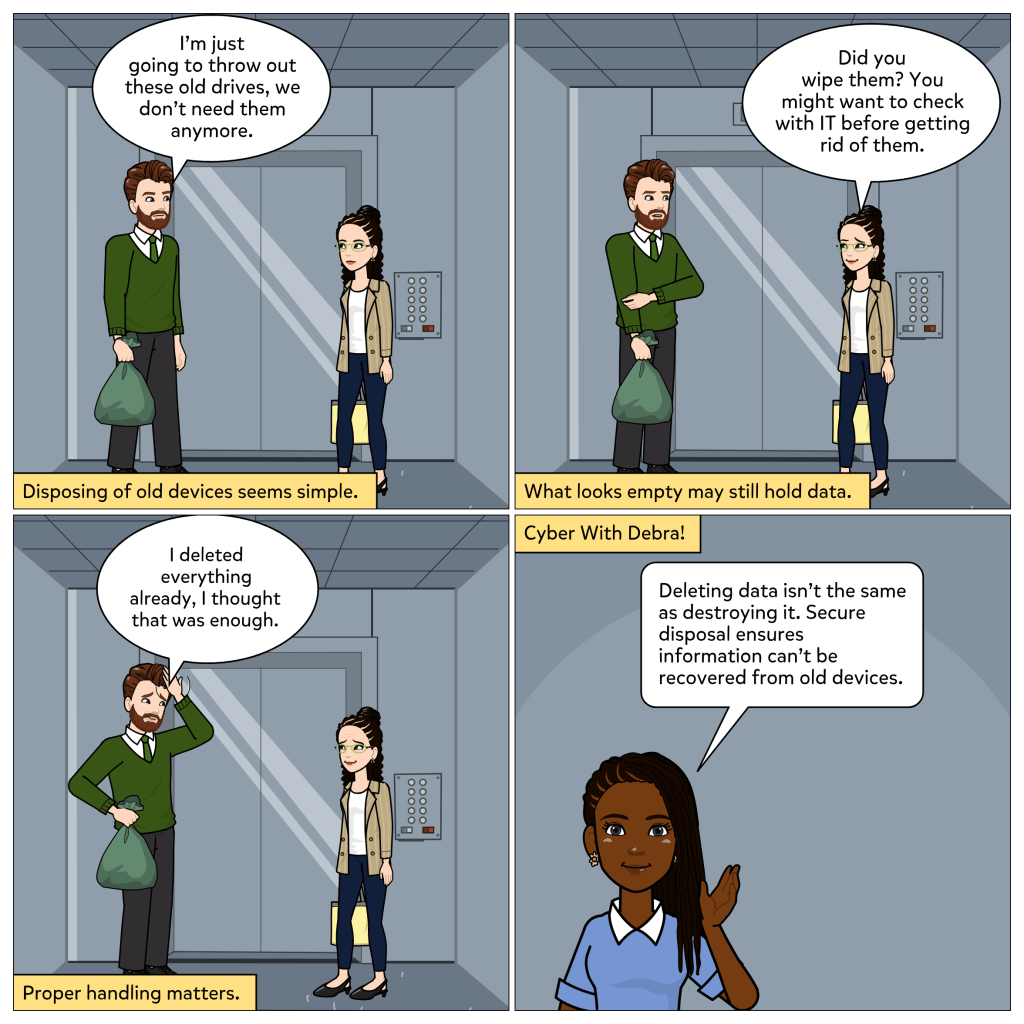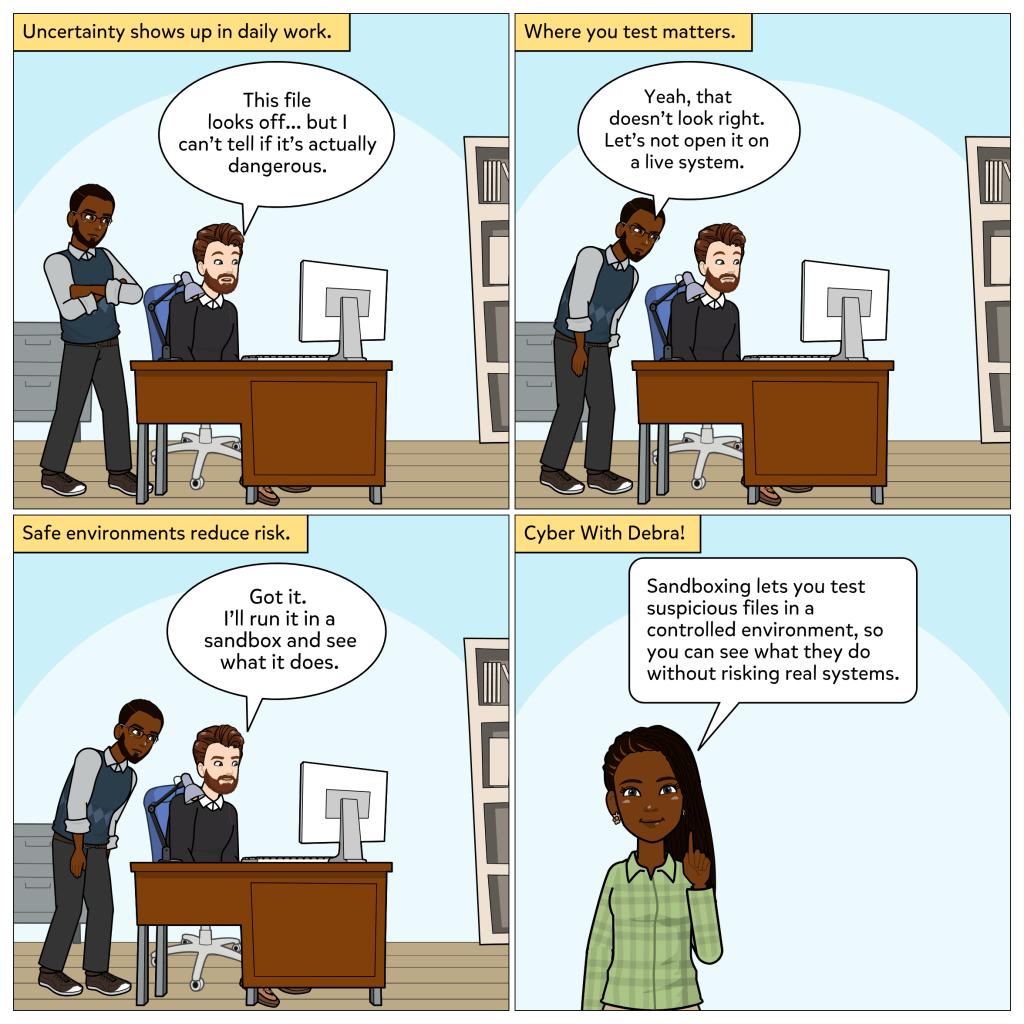
• When a new device is unboxed, most people assume it is ready to use. The truth is that many laptops and systems come with default settings that are far more open than they seem. Features that are rarely needed may be turned on, extra apps may be installed, and unnecessary services may be running in the background. All of these create opportunities that attackers can take advantage of.

    Secure configuration, also called system hardening, reduces those risks. It removes the parts a device does not need and strengthens the settings that matter most.

    In this week’s comic, Joe mentions that his new work laptop came with many features active by default. Debra explains that secure configuration helps remove weak defaults and unnecessary access points. Ray adds that simple steps, such as turning off unused features and uninstalling extra apps, make a device safer from the beginning. Together, they highlight how important it is to tighten systems before problems appear.

    What secure configuration does
    Secure configuration focuses on preparing a device so it is not easy to exploit. The goal is to reduce the number of ways an attacker could get in and to strengthen the areas that protect sensitive information.

    With secure configuration, organizations can:

    Remove unnecessary apps that offer no value but add risk
    Disable unused services and features to limit exposure
    Apply strong settings such as password requirements and access controls
    Ensure devices follow a standard baseline across the organization
    Reduce the attack surface by closing entry points that should not be open

    Secure configuration is not about making a device complicated. It is about making sure it runs only what it needs to run.

    Why it matters
    Attackers often look for the easiest way into a system. Default settings make that easier than most people realize. A service left on, a trial app that was never removed, or a feature that no one uses can each become an entry point.

    By hardening systems from the start, organizations reduce the chances of an attacker finding a weak spot. It also helps protect users, keeps devices consistent, and supports compliance requirements in industries like healthcare and finance.

    Everyday takeaway
    Think of secure configuration like moving into a new home. Even if everything looks clean and ready, you still lock windows, remove items you do not need, and make sure doors are secure. You prepare the space so it is safe, not just functional.

    Good security works the same way. A strong setup at the beginning prevents trouble later.

    Thank you for reading. I hope you have subscribed. Let me know in the comments if you have ever noticed default settings you did not expect on a new device. 🧰

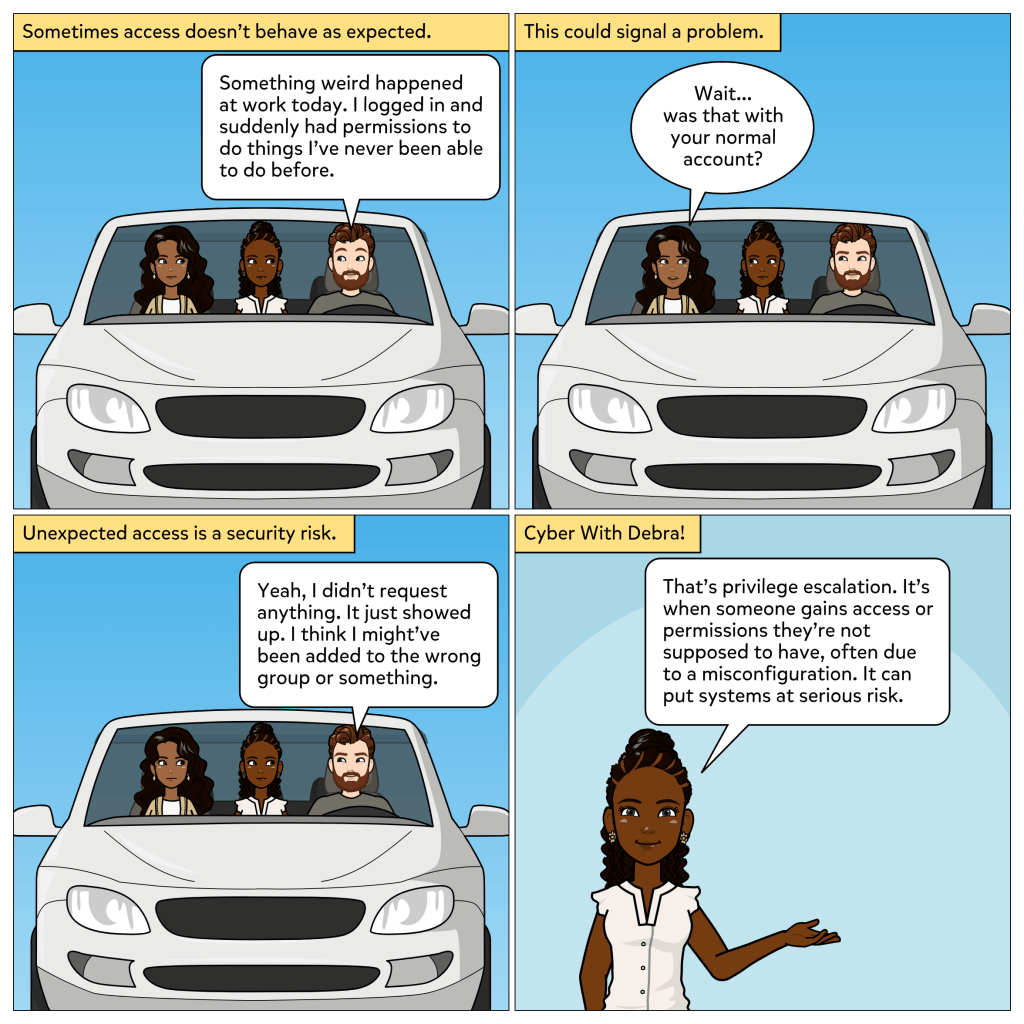
  • There are certain accounts in a system that hold more power than others. They can install software, change settings, view sensitive information, or even shut things down if needed. These are called privileged accounts, and when they are misused or left unmanaged the impact can spread very quickly.

    In this week’s comic, Brittany asks why companies make such a big deal about admin accounts. Debra explains that the more an account can unlock, the bigger the risk if anything goes wrong. It is like holding a master key that opens every door in a building. Convenient, yes, but dangerous if it ever lands in the wrong hands.

    That is where Privileged Access Management, or PAM, comes in. PAM controls who gets high level access, when they get it, and how long they keep it. Instead of leaving powerful accounts always on and always available, PAM makes that access temporary, monitored, and intentional.

    This keeps the impact small if something goes wrong and removes unnecessary opportunities for misuse.

    Why It Matters
    Privileged accounts sit at the heart of every organization. In a hospital that can mean installing updates on medical devices, accessing patient information for troubleshooting, managing electronic health record systems, or configuring imaging or lab equipment. These are tasks that require trust and precision because one wrong change can affect patient care or the flow of information.

    If a privileged account is compromised, the attacker does not start at the bottom. They start with power. They start with reach. And they start with a path that can spread quickly.

    PAM reduces that risk by limiting what those accounts can do and when they can do it. It also adds layers such as

    • Just in time access that appears only when needed
    • Automatic expiration once the task is complete
    • Session monitoring that records what was accessed and why
    • Least privilege so people only get the access they truly need

    PAM keeps elevated access from becoming an open invitation.

    Everyday Takeaway
    Power is not the problem. Uncontrolled power is. When high level accounts are tightly managed, monitored, and temporary, security becomes stronger for everyone.

    Security always comes back to awareness. Privileged accounts make our work easier, but they also remind us to be intentional about who gets high level access and when.

    So the question becomes simple. How is privileged access handled in your world and what guardrails are in place to keep it safe Today’s choices shape tomorrow’s security. 🛡️

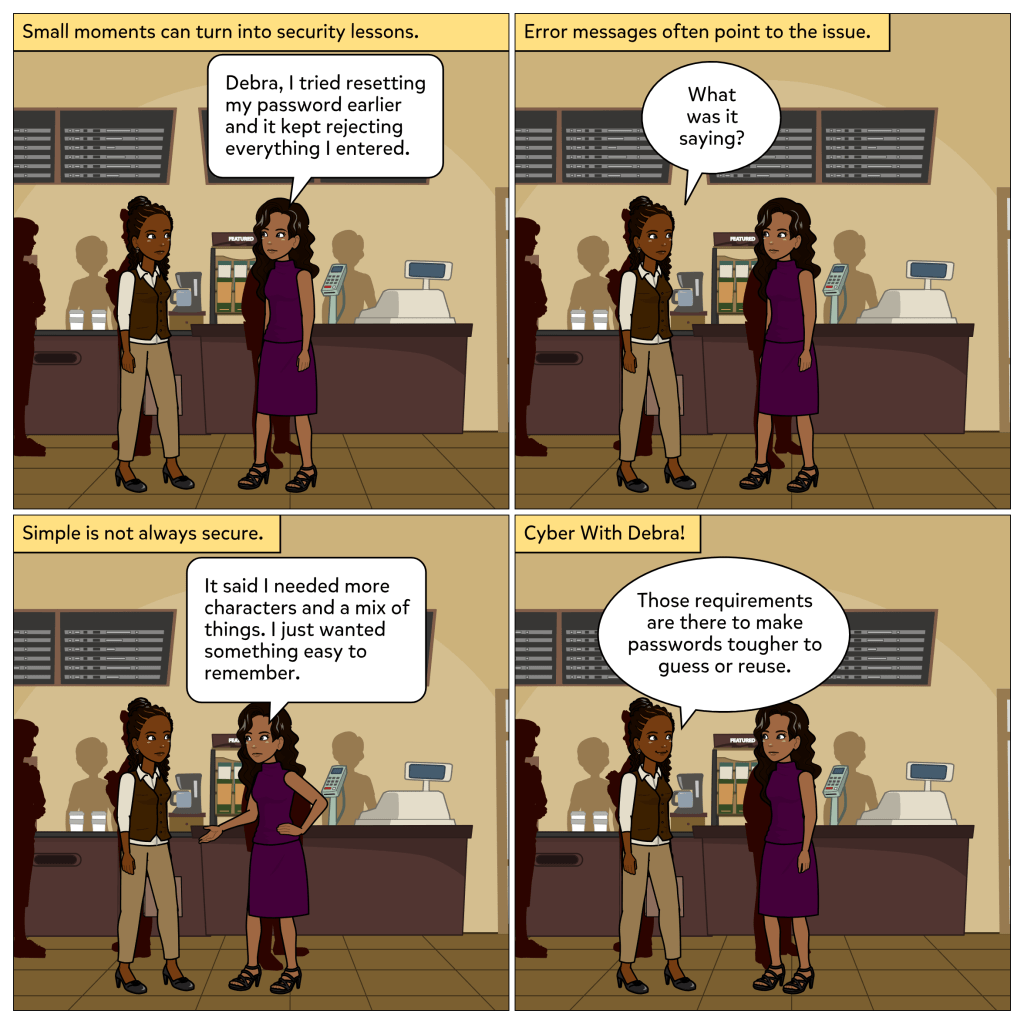
  • Passwords have been around for a long time, but they are no longer enough to keep accounts safe. They can be guessed, shared, reused, or stolen without anyone noticing. That is why many apps and systems now use Multi Factor Authentication, or MFA. It adds another step to confirm identity before access is granted.

    In this week’s comic, Sandy asks Debra why some logins require more than a password. Debra explains that MFA uses more than one way to verify who is signing in. A password is something you know, but MFA adds something you have, such as a code, or something you are, such as a fingerprint. Even if an attacker steals a password, they cannot get past the next step.

    What MFA does
    MFA works by combining different types of checks so access is not based on a password alone. These checks fall into three categories.

    Something you know such as a password or PIN
    Something you have such as an authentication app or one time code
    Something you are such as a fingerprint or face scan

    By using more than one factor, MFA makes it much harder for attackers to break into accounts. Even if one layer fails, the others stand in the way.

    Why it matters
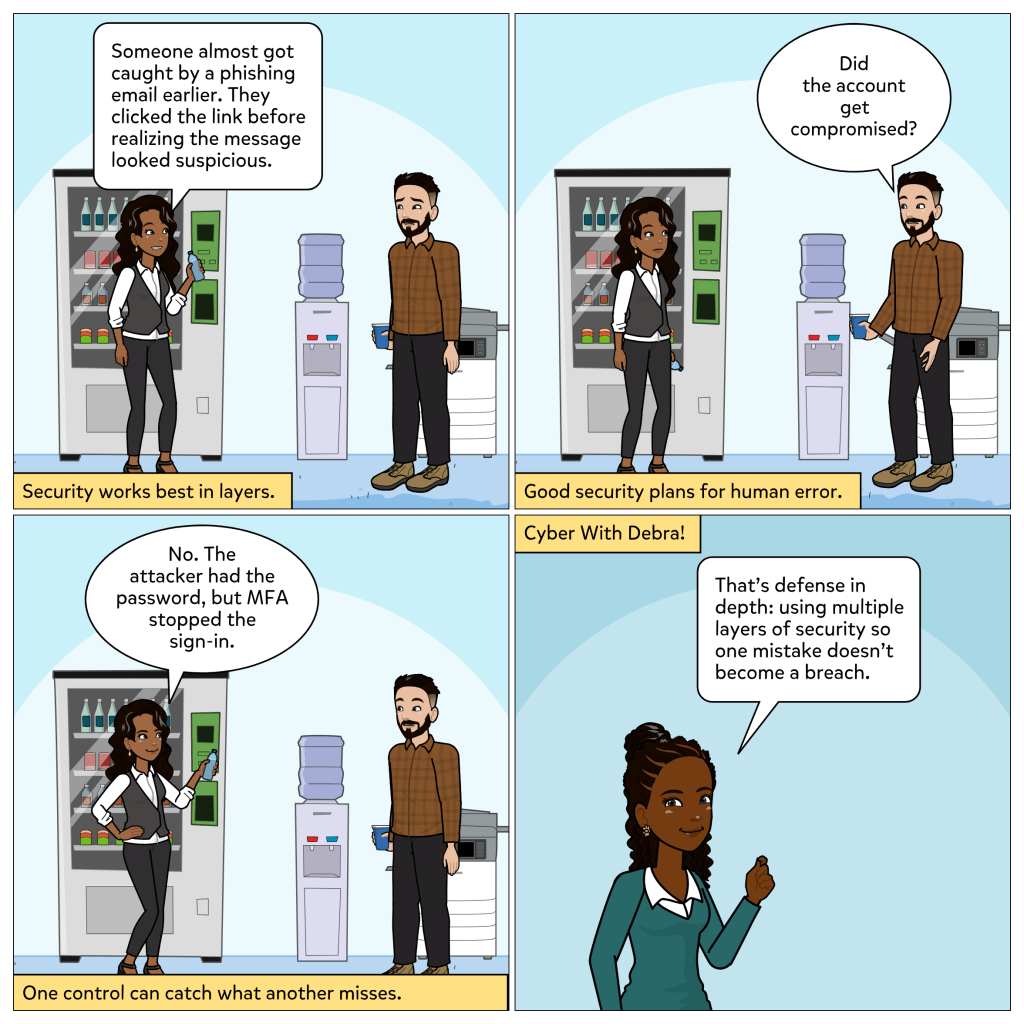
    Most security breaches start with compromised credentials. That means an attacker found or guessed someone’s password. MFA strengthens the sign in process by confirming a person’s identity from more than one angle. It protects email accounts, banking apps, health portals, and workplace systems from unauthorized access.

    For industries like healthcare and finance, where sensitive information is constantly protected, MFA helps keep data safe without slowing down daily work.

    Everyday takeaway
    Think of MFA like the locks on your front door. A key alone is helpful, but pairing it with a door code makes your home safer. Even if someone finds the key, they still cannot enter without the code.

    Good security uses layers, not a single barrier. MFA gives that extra layer that stops attackers before they get inside.

    Thank you for reading. I hope you have subscribed. Let me know in the comments if you use MFA in your daily apps and services. 🔐

  • Every organization runs on access. Employees need to reach files, systems, and tools to get their work done. But if everyone can access everything, sensitive data quickly becomes exposed. That is where Identity and Access Management, or IAM, comes in.

    IAM controls who can do what within a system. It makes sure the right people have the right access at the right time.

    In this week’s comic, Michelle tries to open a folder and is surprised when access is denied. Debra explains that the folder is restricted to the finance team. IAM uses roles and permissions to make sure only authorized users can reach certain data. Each request is reviewed before access is granted, keeping systems secure and organized.

    What IAM does
    IAM gives organizations the structure to manage identities and permissions efficiently. It is the foundation of access control and accountability.

    With IAM, organizations can:

    Authenticate users to verify who they are
    Authorize access to only what is needed for each role
    Manage permissions through approval workflows
    Monitor activity to detect unusual access patterns

    Together, these steps help maintain visibility and trust across digital systems.

    Why it matters
    When access is too open, a single compromised account can cause major damage. IAM limits that risk by enforcing clear boundaries. It is especially important in industries like healthcare and finance, where privacy laws require strict control over who can view or modify sensitive information.

    IAM also supports the principle of least privilege, meaning every user has exactly what they need to do their job and nothing more. That balance keeps security strong without slowing down productivity.

    Everyday takeaway
    Think of IAM like a building with secure rooms. Employees can enter the lobby freely, but only those with the right clearance can open specific doors. Each level of access protects something valuable inside.

    Good security is not only about keeping outsiders away. It is also about managing trust within.

    Thank you for reading. I hope you have subscribed. Let me know in the comments how your organization handles access control and user permissions. 🔑

  • It does not always take a hacker to cause a data breach. Sometimes, information leaves an organization by accident, such as a file emailed to the wrong person, a report uploaded to a public folder, or sensitive data saved on an unsecured drive.

    That is where Data Loss Prevention, or DLP, comes in.

    DLP is a security approach that helps organizations protect sensitive information by monitoring, detecting, and blocking risky actions. It keeps data from being shared where it should not go, whether the leak is intentional or not.

    In this week’s comic, Brittany tries to email a report to her personal account to finish it later. The system immediately blocks the message, recognizing that it contains confidential data. Debra explains that this is how DLP helps prevent leaks before they happen. Data protection is not just about keeping threats out. It is also about keeping information where it belongs.

    What DLP does
    DLP solutions look for patterns or rules that match sensitive information such as credit card numbers, health records, or financial data. When a match is found, the system can alert the user, block the action, or encrypt the data automatically.

    With DLP, organizations can:

    Identify sensitive data across emails, files, and cloud storage
    Monitor how that data is being shared or moved
    Prevent unauthorized transfers through alerts or blocks
    Comply with privacy laws and data protection standards

    Why it matters
    Every organization handles sensitive data, from patient information in healthcare to financial details in banking. A single accidental email or upload can expose private information and lead to costly consequences.

    DLP adds a layer of protection that focuses not on systems but on the data itself. It keeps security grounded in what truly matters, protecting the information people trust organizations to handle safely.

    Everyday takeaway
    Think of DLP like the locks on file cabinets in an office. Even if someone walks in with good intentions, they cannot open a drawer without permission. It is not about mistrust. It is about keeping private information private.

    Good security is not only about stopping attacks from the outside. It is also about preventing mistakes from the inside.

    Thank you for reading. I hope you have subscribed. Let me know in the comments how you make sure sensitive information stays where it should. 🗂️

  • Security teams today face more alerts than they can count. Each one might represent a potential threat, but reviewing them all takes time. The longer it takes to respond, the greater the risk. That is where SOAR comes in.

    SOAR stands for Security Orchestration, Automation, and Response. It helps organizations manage alerts by connecting tools, automating repetitive steps, and coordinating how teams respond. Instead of getting buried in notifications, analysts can focus on the alerts that matter most.

    In this week’s comic, Maria feels overwhelmed by the constant flow of alerts. Debra explains how SOAR handles the routine work, like opening tickets or isolating a suspicious device, so the team can move faster. Together, they show how automation supports people, not replaces them.

    What SOAR actually does
    SOAR combines information from tools like SIEM systems, firewalls, and endpoint protection platforms. It uses workflows, sometimes called playbooks, to perform certain tasks automatically.

    With SOAR, teams can:

    Automate simple but time-consuming actions, such as blocking IPs or collecting logs
    Orchestrate different tools so they work together instead of separately
    Respond consistently to incidents using structured workflows
    Improve efficiency by saving time on repetitive steps

    Why it matters
    Even the best analysts can only handle so much. SOAR makes security operations more efficient by reducing alert fatigue and ensuring quick, consistent responses. It does not replace human judgment but strengthens it by removing the repetitive noise that slows analysts down.

    In fast-moving industries like finance and healthcare, that speed matters. Automated responses keep systems resilient and ensure threats are handled before they spread.

    Everyday takeaway
    Think of SOAR like an automated assistant in a busy office. Instead of manually sorting every document or email, the assistant organizes them so you can focus on what really needs your attention. The work still gets done, just smarter.

    Automation does not take away from the human side of security. It gives people more time to think, plan, and protect.

    Thank you for reading. I hope you have subscribed. Let me know in the comments what routine task you wish could be automated in your daily work. ⚙️

  • In cybersecurity, trust without verification is a risk few organizations can afford. The idea that everyone inside a network is automatically safe no longer holds up. That is why more industries, including banking, are turning to a Zero Trust approach.

    Zero Trust means no one is trusted automatically. Every user, device, and connection must verify who they are before gaining access. It is not about suspicion. It is about assurance.

    In this week’s comic, Debra and Ray walk through a bank where security depends on constant verification. Ray is surprised that even employees must reverify to move between areas. Debra explains that this is the point of Zero Trust, protecting data by confirming access at every step.

    What Zero Trust really means
    Zero Trust is built on a straightforward principle, never trust, always verify. It recognizes that modern threats can come from anywhere, even from inside an organization. The model focuses on controlling access, validating identity, and monitoring activity continuously.

    A strong Zero Trust framework often includes:

    Identity verification using methods like multi-factor authentication
    Device validation to confirm systems are updated and secure
    Least privilege access so users only have the permissions they need
    Ongoing monitoring to detect and respond to unusual behavior

    Why it matters
    In sectors like banking or healthcare, where information is sensitive and regulated, Zero Trust limits the damage one compromised account or device can cause. It replaces broad, open access with a model built on context and verification.

    Zero Trust works because it closes gaps quietly and consistently. It is less about walls and more about awareness, knowing who is connected, what they are doing, and why.

    Everyday takeaway
    Think of it like walking through different parts of a bank. Even as an employee, you cannot enter every area without checking in first. Those extra steps protect the vault, the data, and everyone who depends on them.

    Zero Trust brings that same discipline to cybersecurity. It turns verification into protection, one access request at a time.

    Thank you for reading. I hope you have subscribed. Let me know in the comments how your view of trust has evolved in the digital age. 🔐

  • Every system, device, and application has weaknesses that can be discovered and fixed. The key is finding them before attackers do. That is what vulnerability management is all about.

    In this week’s comic, Joe feels overwhelmed by a long list of vulnerabilities from a system scan. Debra explains that this is completely normal. Not every issue is urgent, but some can open serious risks if ignored. Together, they walk through how prioritizing, patching, and staying proactive keeps a network secure.

    What vulnerability management does
    Vulnerability management is the process of identifying, assessing, prioritizing, and fixing weaknesses across systems and devices. It is a continuous cycle, not a one-time task.

    The process usually involves:

    Scanning systems to find known weaknesses or outdated software.
    Prioritizing issues based on their level of risk or exposure.
    Patching or mitigating those vulnerabilities before they can be exploited.
    Reviewing regularly to make sure new risks are addressed as they appear.

    Vulnerability management tools can automate scans and help track what has been fixed, but human judgment is still key. Security teams decide which vulnerabilities matter most to their environment and act accordingly.

    Why it matters
    Attackers often look for the simplest path in, such as an unpatched system, an outdated program, or a forgotten server. By keeping systems up to date, organizations remove many of those easy opportunities.

    Vulnerability management does not just fix problems. It helps teams understand their systems better, plan updates more strategically, and strengthen their overall defense.

    Everyday takeaway
    Think of it like maintaining a building. Cracks in the wall or loose bolts might not cause immediate damage, but ignoring them makes the structure weaker over time. Routine checks and quick fixes prevent bigger issues later.

    The same principle applies to cybersecurity. Regular scanning, reviewing, and updating keep your digital environment strong and resilient.

    Thank you for reading. I hope you have subscribed. Let me know in the comments how you stay proactive about updates and security in your daily work. 🧱

  • Security data comes from everywhere, including firewalls, servers, endpoints, cloud platforms, and user activity. Each tool generates its own alerts and logs, but seeing how those pieces fit together is the challenge. That is where SIEM, or Security Information and Event Management, comes in.

    In this week’s comic, Joe and Maria talk about that very problem. They have tools collecting data across their environment, but it is hard to tell what connects. Maria explains correlation, how logs, alerts, and events are all part of the same story. Once everything is viewed together, patterns begin to emerge. Then Debra ties it all together, explaining how SIEM gives security teams the visibility and speed they need to respond faster.

    What SIEM actually does
    A SIEM system gathers logs and alerts from across an organization’s network, analyzes them, and identifies activity that might indicate a threat. Instead of looking at each alert separately, the SIEM helps analysts see the full picture and how one small event might link to another.

    With SIEM, teams can:

    Collect data from many sources such as firewalls, servers, and applications.
    Correlate events to find connections that may point to an attack.
    Alert analysts in real time when patterns look suspicious.
    Report on trends to help improve security over time.

    Some of the most well-known SIEM tools in use today include Splunk, IBM QRadar, Microsoft Sentinel, Wazuh, and Elastic Security. Each platform works a little differently but they share the same goal, giving teams visibility and context across their environment.

    Why it matters
    When alerts come from many directions, it is easy to miss the bigger story. A failed login here, a strange network request there, or an unexpected file change somewhere else may not seem serious on its own. But when combined, they can reveal a coordinated attack.

    That is why SIEM is often called the command center of cybersecurity. It turns data into insight and helps security teams move from reacting to predicting.

    Everyday takeaway
    Think of SIEM like the central control room in a busy building. Cameras, alarms, and sensors all feed into one screen so nothing is overlooked. It is not about adding more tools but about bringing clarity to what you already have.

    Visibility brings understanding, and understanding leads to action.

    Thank you for reading. I hope you have subscribed. Let me know in the comments how you think visibility shapes better response in security. 🧩

  • In cybersecurity, we spend a lot of time talking about prevention, with firewalls, encryption, segmentation, and endpoint security. But what happens when something slips through? That is where incident response comes in.

    Incident response is the plan for how teams identify, contain, and recover from security incidents. It is not about panicking when something unusual happens. It is about having a process that keeps small problems from turning into major disasters.

    In this week’s comic, the team walks through the flow of incident response, showing how preparation, detection, analysis, containment, recovery, and lessons learned all come together.

    Preparation
    Preparation is the foundation. Policies, tools, and backups put you in a stronger position before an incident ever happens. Without preparation, every response is slower and riskier. Being ready makes all the difference.

    Detection
    The response process really begins when suspicious activity is identified. That could be an alert from a system, unusual behavior spotted by an analyst, or even a report from a user. Early detection buys time. The sooner something is noticed, the faster a response can begin.

    Analysis and Containment
    Once something is detected, the next step is to confirm what is happening and take action to stop the spread. This is where analysis comes in. Logs are reviewed, alerts are examined, and the team decides how to contain the problem. Containment prevents a local issue from becoming a system-wide crisis.

    Recovery and Lessons Learned
    Once the immediate problem is contained, recovery focuses on restoring systems and making sure they are safe to use again. But recovery is not the end. A strong incident response plan always includes lessons learned. Each incident becomes an opportunity to strengthen the process so the team is better prepared next time.

    Everyday takeaway
    Think of it like handling a kitchen fire. Preparation means having a fire extinguisher. Detection is noticing smoke or flames. Analysis and containment is grabbing the extinguisher and putting out the fire before it spreads. Recovery is cleaning up and replacing what was damaged. Lessons learned might be updating the smoke detectors or storing flammable items more safely.

    Cybersecurity incidents may look different, but the principle is the same. Preparation and process turn chaos into control.

    Thank you for reading. I hope you have subscribed. Let me know in the comments what part of the response process stood out to you the most. 📝