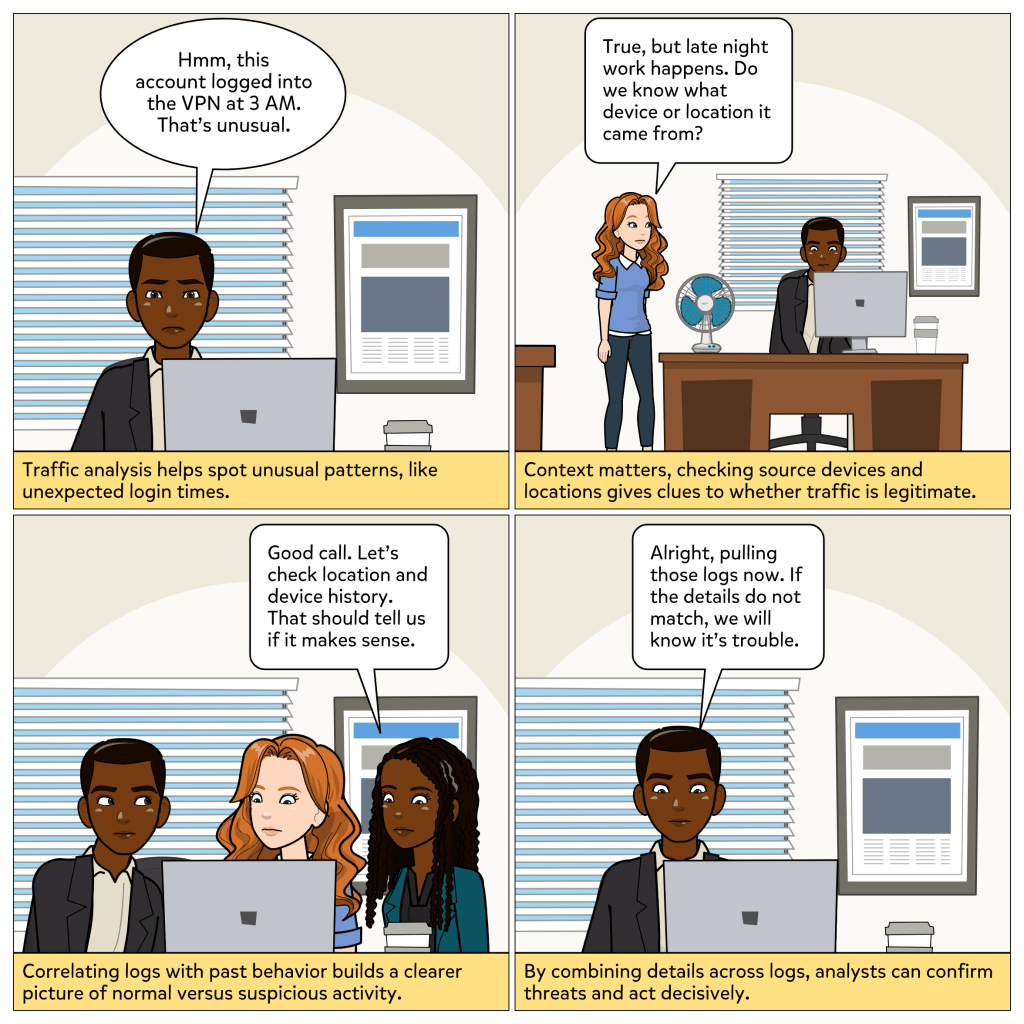
Ray notices something unusual in the logs. A VPN login from a finance account shows up at 3 AM. That is odd enough to raise an eyebrow, but unusual timing by itself does not always mean trouble.
Brittany points out the obvious: sometimes people really do work late. The real question is what else the logs reveal. Was the login from a trusted device? Did it come from a normal location? That is where context becomes key.
Debra joins in and suggests checking location and device history. If they align with what is expected, the login is likely fine. If not, it could be an early signal of a compromise. This step of traffic analysis is about connecting different pieces, timing, devices, and past patterns, to see whether an event fits normal behavior.
Ray begins pulling the details together. By correlating logs and cross checking patterns, the team can separate a harmless late night login from something suspicious. When the information does not match, it is a clear sign to investigate further and act quickly.
What this means for network security
Traffic analysis is a core practice in network security. It is not about looking at one number or one log in isolation. Instead, it examines how data flows, when people connect, from where, using which devices, and whether the activity makes sense in context.
For example, a login at 3 AM from an employee who is traveling might be perfectly fine. But if the same login comes from an unfamiliar device in a location the company has no ties to, that is a red flag. By piecing together multiple signals, traffic analysis builds a picture of what normal looks like and spots when something does not belong.
A healthcare lens
In hospitals, traffic analysis plays a similar role. Imagine an infusion pump that usually sends status updates once every hour. If suddenly the pump begins sending thousands of messages per minute, that traffic pattern is suspicious. It could mean a malfunction, or worse, that the device is being exploited.
Another example is electronic health record access. A nurse may normally log in from the same workstation during their shift. If the system sees a login from a different city or from multiple devices at once, traffic analysis can flag it as abnormal. In environments where every second matters, spotting these irregularities can prevent both patient safety issues and data breaches.
Everyday takeaway
Not every unusual activity is a threat, but ignoring small signs can give attackers an open door. Traffic analysis helps teams tell the difference between a late night of work and a suspicious login attempt.
Awareness of normal patterns is the first step. The more clearly you can read between the lines of your network traffic, the stronger your defense becomes. 💪🏾

 Cyber With Debra!
Leave a comment