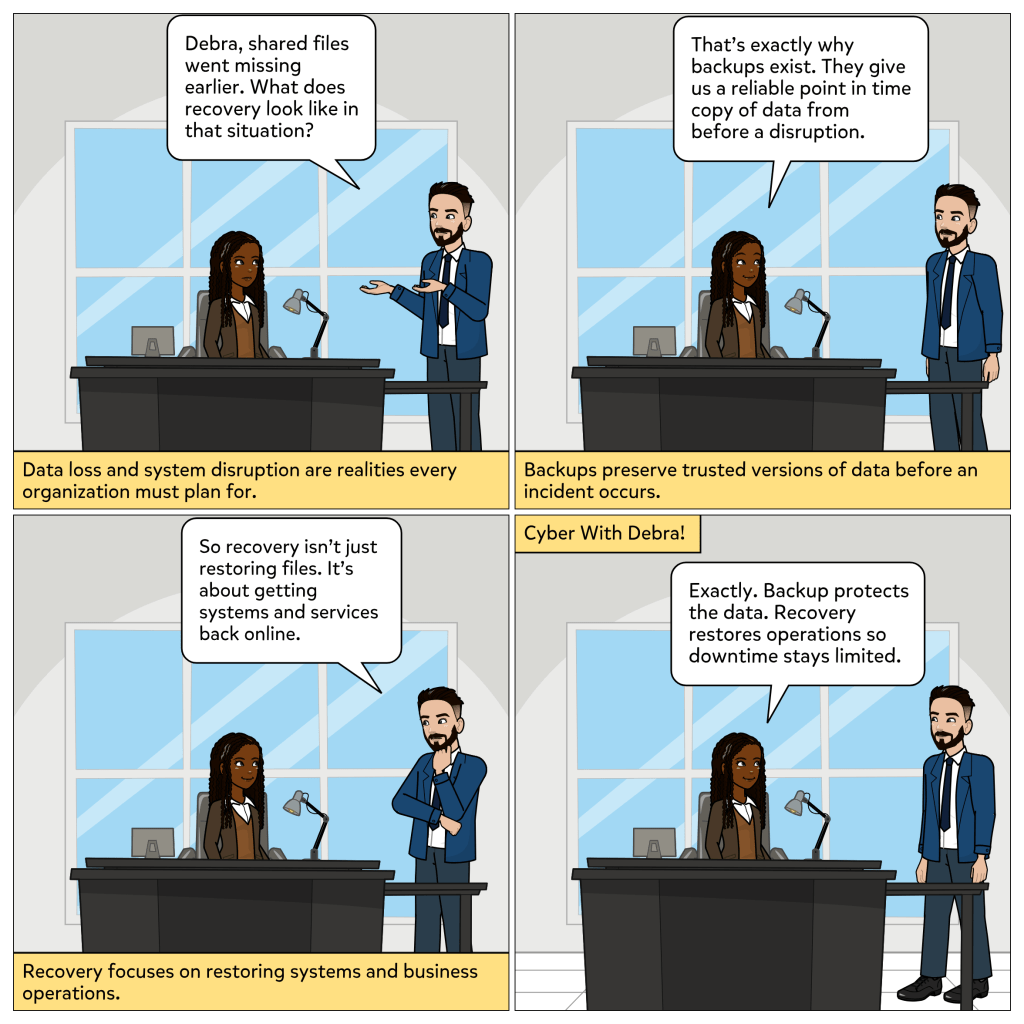
When people think about backups, they often picture a safety net. Something you set up once and hope you never need. But in the real world, backups and recovery are not the same thing, and understanding the difference matters more than most people realize.
In this comic, Joe walks into Debra’s office with a real concern. Shared files went missing earlier, and he wants to know what recovery actually looks like in that situation. It is a familiar moment in many organizations, especially in environments where data is constantly being created, edited, and shared.
What this means
Backups exist to preserve trusted versions of data. They give organizations a reliable point in time copy from before something went wrong, whether that was accidental deletion, system failure, or a security incident.
Recovery is what happens next. It is the process of restoring files, systems, and services so people can get back to work. Recovery is not only about bringing data back. It is about making systems usable again, reconnecting services, and minimizing disruption to daily operations.
That distinction is important. A backup that cannot be restored quickly or correctly does not help when systems are down and work has stopped.
Why it matters
Data loss and system disruption are not rare events. They are realities every organization must plan for, especially in healthcare, finance, and other critical environments where downtime can have serious consequences.
Effective backup and recovery planning helps limit how long systems are unavailable, reduces operational stress, and supports business continuity. It also plays a key role in incident response, giving teams a way to recover safely without relying on compromised or corrupted data.
Recovery planning forces organizations to think beyond saving data and focus on how quickly and reliably they can return to normal operations.
Everyday takeaway
Backups protect the data.
Recovery restores the business.
Both are needed, and neither should be treated as an afterthought.
Thanks for reading. If this series has been helpful, feel free to share it with someone who works with systems, data, or operations. 🗂️
 Cyber With Debra!
Leave a comment