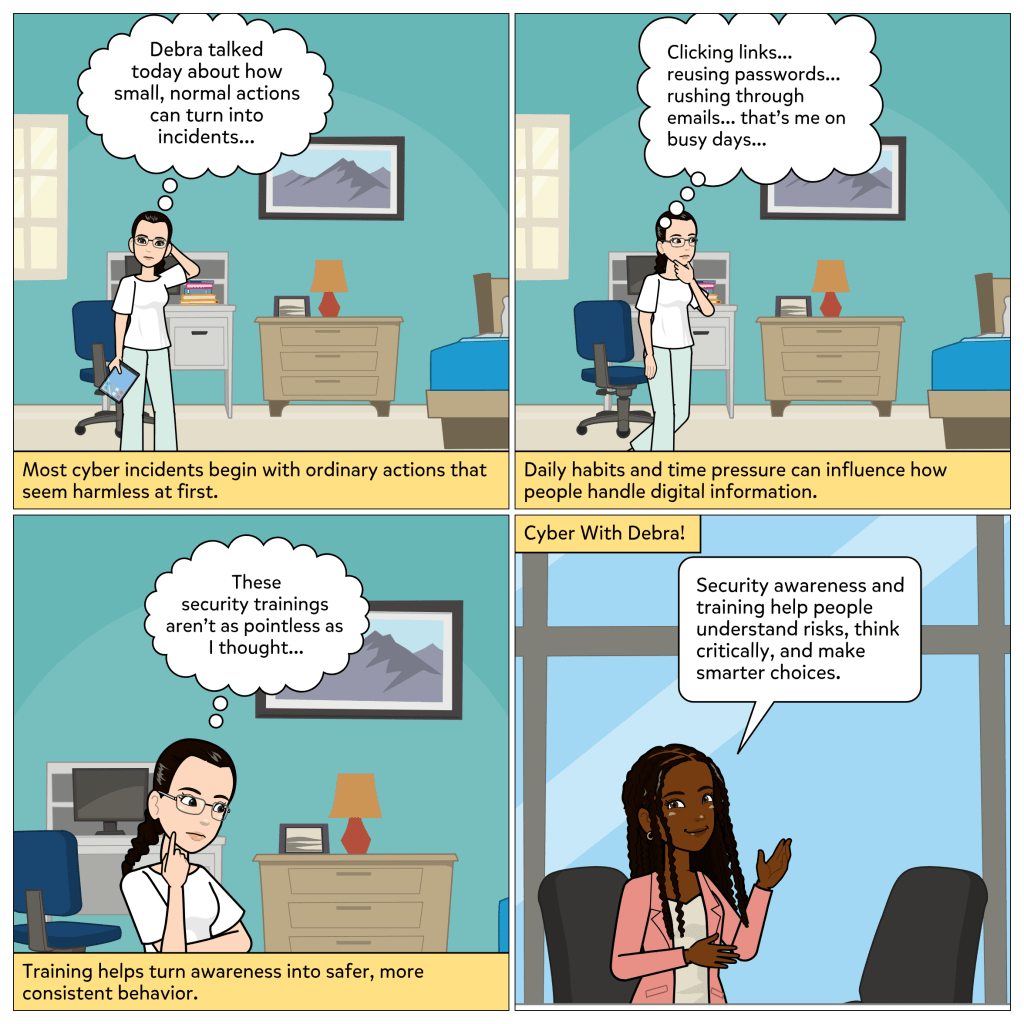
Security incidents rarely start with something dramatic. Most of the time, they begin with small, normal actions that do not feel risky in the moment.
Clicking a link while multitasking.
Reusing a password because it is convenient.
Rushing through emails on a busy day.
These are everyday habits, and they are exactly why security awareness and training matter.
In this week’s comic, Maria reflects on a security training provided earlier in the day. Debra had explained how ordinary actions can turn into security incidents. Later that evening, as Maria goes about her routine, those ideas start to resurface. She recognizes her own habits and realizes that the training was not pointless after all. It helped her pause, think, and connect the dots.
That pause is where awareness begins to work.
What security awareness and training really do
Security awareness is not about memorizing rules or passing quizzes. It is about helping people understand how risk shows up in everyday situations.
Effective security awareness and training help organizations by:
• Teaching people how attackers take advantage of routine behavior
• Helping employees recognize warning signs before incidents occur
• Encouraging thoughtful decision-making under time pressure
• Reducing mistakes caused by assumptions or familiarity
• Reinforcing consistent, safer habits over time
Training does not eliminate risk. It reduces the likelihood that small actions turn into larger problems.
Why it matters
Many security incidents do not happen because someone intended harm. They happen because someone did not recognize risk in the moment.
Attackers rely on distraction, urgency, and familiarity. They count on people being busy, tired, or rushed. When awareness is low, those tactics work more easily. When awareness is present, people slow down, question what they see, and make better choices.
Security awareness shifts security from being a technical issue to a shared responsibility.
Everyday takeaway
Security awareness is not about being perfect. It is about being mindful.
The goal is not to catch every threat. The goal is to recognize when something deserves a second look. Training plants that awareness so it shows up later, even outside of work hours, in quiet moments when decisions are being made.
That is when security awareness is doing its job.
Thank you for reading. I hope you are subscribed. Let me know in the comments what everyday habits have made you stop and think twice lately. 🧠
 Cyber With Debra!
Leave a comment