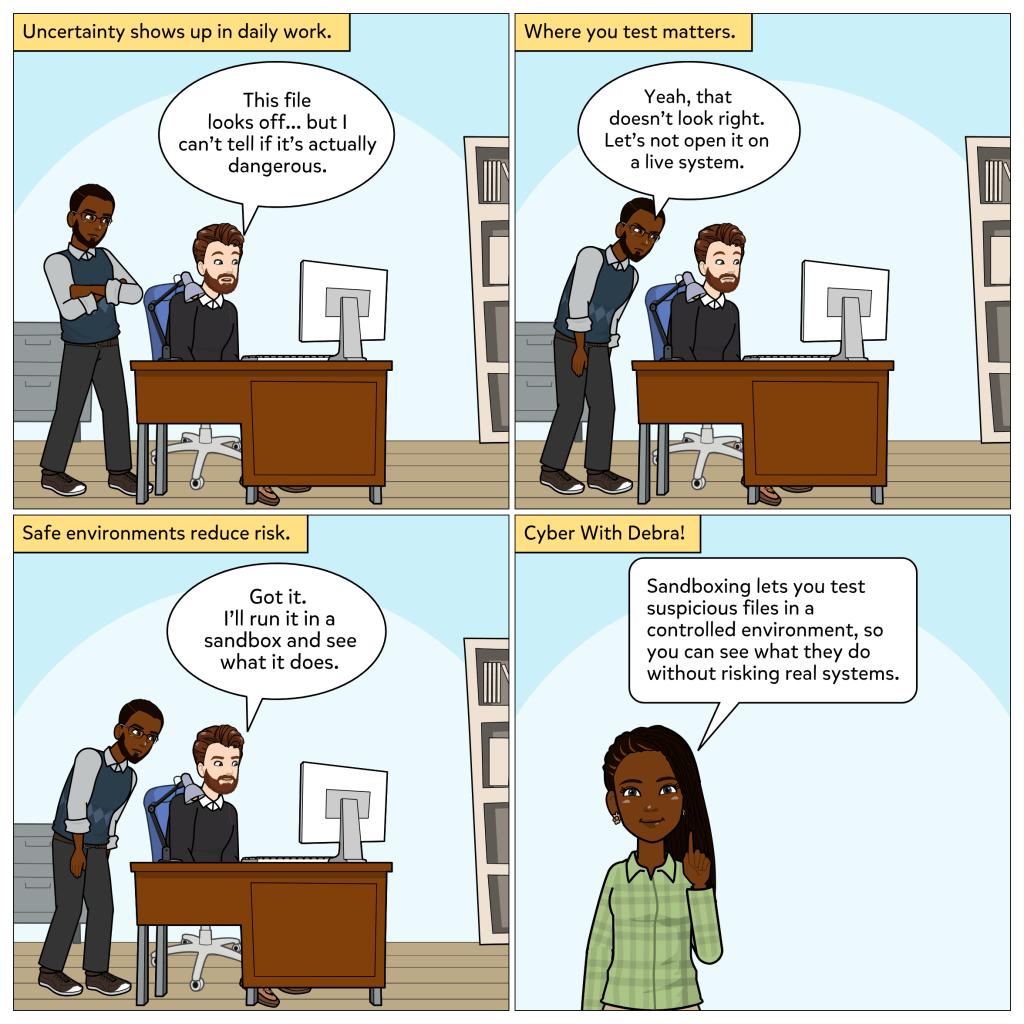
Uncertainty shows up in daily work. Not every file, alert, or activity is immediately clear.
In this week’s comic, Jake notices a file that seems off but cannot confirm whether it is actually dangerous. Instead of taking a risk, Ray steps in and suggests something important. Do not open it on a live system.
Jake agrees and decides to run the file in a sandbox to observe its behavior safely.
That decision highlights a key concept in cybersecurity.
What sandboxing really means
Sandboxing is the practice of running suspicious files, code, or applications in a controlled and isolated environment.
This environment is designed to safely observe behavior without affecting real systems, networks, or data.
If the file turns out to be malicious, the impact is contained within the sandbox. If it is harmless, it can be handled appropriately without unnecessary risk.
Why it matters
Not every threat is obvious at first glance. Some malicious files are designed to appear normal and only reveal harmful behavior once executed.
Opening a suspicious file directly on a live system can lead to:
• Malware infections
• Data exposure
• System compromise
• Lateral movement within a network
Sandboxing reduces this risk by creating a safe space to test before taking action.
Everyday takeaway
Security is not only about identifying threats. It is about how you handle uncertainty.
When something looks off, the safest approach is not to ignore it or rush into action. It is to test it in a way that protects everything else.
Where you test matters just as much as what you test.
Thank you for reading. I hope you are subscribed. Have you ever come across something that looked suspicious but turned out to be harmless, or the opposite? Let me know in the comments.
🔍
 Cyber With Debra!
Leave a comment