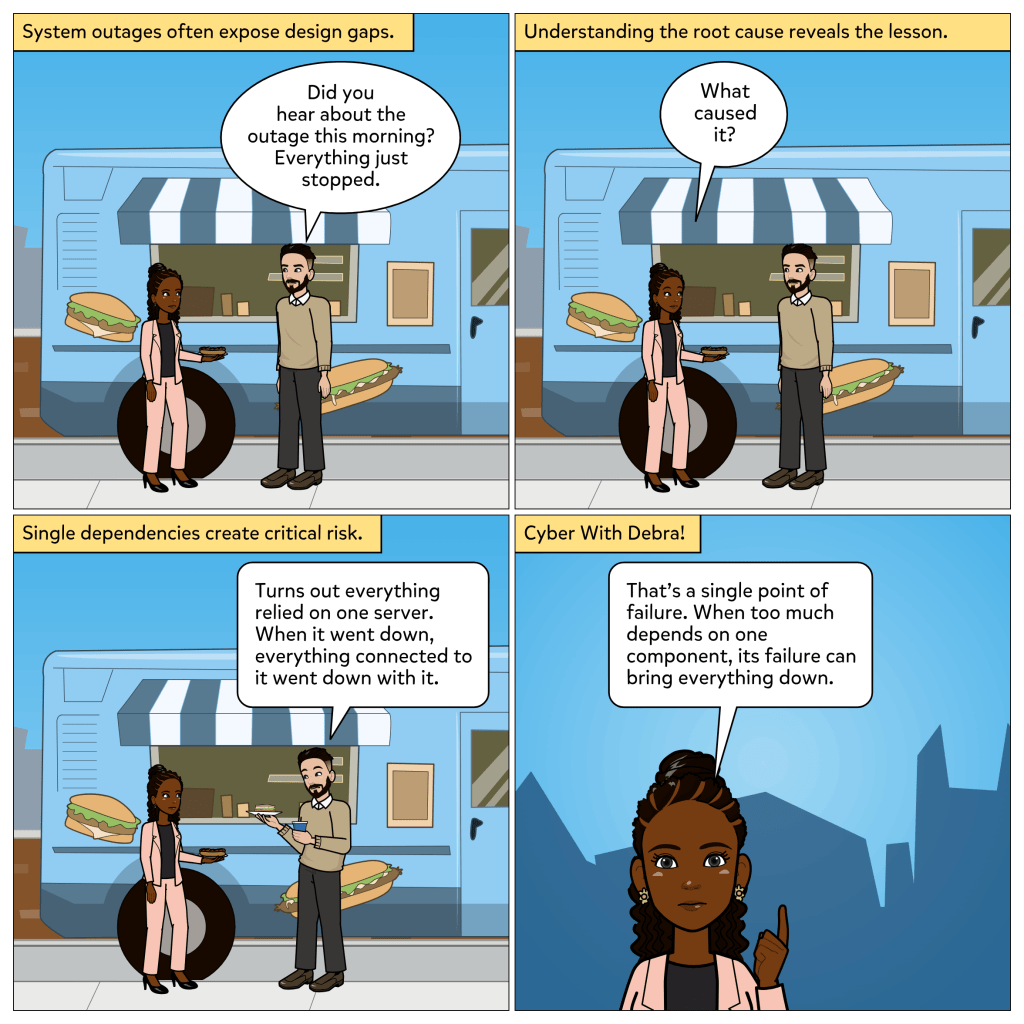
System outages often feel sudden, but they rarely happen without a reason.
In this week’s comic, Joe brings up an outage from earlier in the day. Everything stopped unexpectedly. What seemed like a widespread issue turned out to have a single cause.
One server went down, and everything connected to it went down with it.
That moment highlights something important.
What a single point of failure really means
A single point of failure is any component in a system that, if it fails, can cause the entire system to stop working.
This could be:
• a server
• a database
• a network device
• even a single process or dependency
When too much relies on one component, its failure has a much larger impact.
Why it matters
Systems are often built to handle complexity, but not always built to handle failure.
When there is no backup, redundancy, or alternative path, a single issue can lead to:
• complete system outages
• disruption of operations
• delays in critical services
• loss of productivity
The risk is not just the failure itself. It is how much depends on it.
Everyday takeaway
Security is not only about preventing attacks. It is also about designing systems that can continue to function when something goes wrong.
Reducing single points of failure means planning for failure, not just hoping it does not happen.
Because sometimes, all it takes is one.
Thank you for reading. I hope you are subscribed. Have you ever experienced a situation where one small issue caused a much bigger disruption? Let me know in the comments ⚠️


Leave a Reply