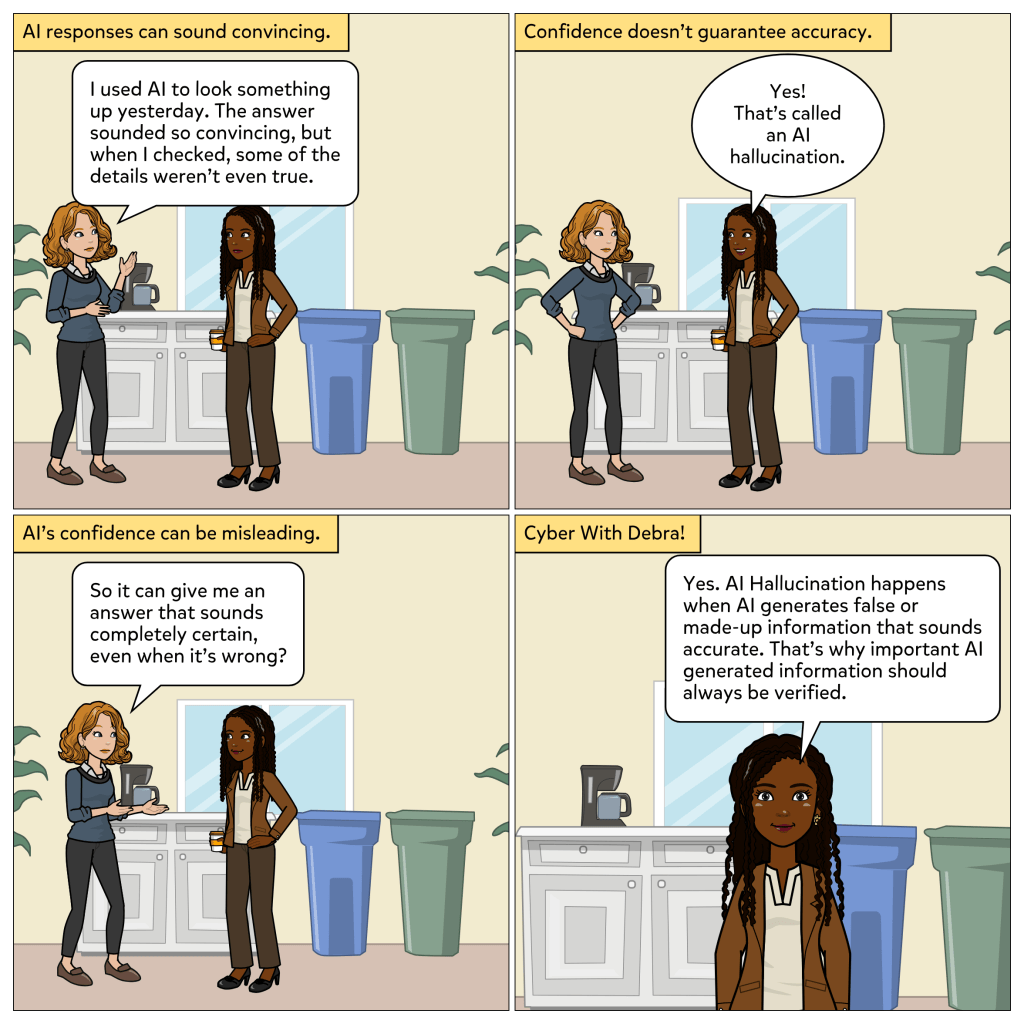
Have you ever asked an AI tool a question, received a convincing answer, and later discovered that some of the information wasn’t actually true?
One of the challenges with artificial intelligence is that it can generate responses that sound accurate and confident, even when they’re incorrect. This is known as an AI hallucination.
What it means
An AI hallucination occurs when an AI system generates false, inaccurate, or misleading information and presents it as though it were factual.
This can happen in different ways. An AI system might invent a statistic, provide an incorrect explanation, reference a source that doesn’t exist, or include details that were never part of the original information. What makes hallucinations particularly concerning is that the responses can sound just as convincing as accurate ones.
Why do AI hallucinations happen?
As we’ve explored in previous posts, generative AI learns patterns from large amounts of training data and uses those patterns to generate responses. However, generating a response is not the same as verifying that the information is true.
AI models can sometimes produce incorrect information because of limitations in their training data, difficulties interpreting context, or the way they generate responses based on learned patterns. Instead of recognizing that it doesn’t have enough reliable information, an AI system may generate an answer that appears reasonable but is factually incorrect. This is why a confident sounding response doesn’t necessarily mean the information is accurate.
What does an AI hallucination look like?
Imagine asking an AI tool to summarize a report for an upcoming meeting. The summary looks professional, well organized, and easy to understand. However, when you compare it with the original report, you discover that the AI included a statistic that was never mentioned. That invented statistic is an example of an AI hallucination.
Other examples include AI generating nonexistent research citations, inventing historical events, or providing incorrect technical instructions. The challenge is that these errors are not always obvious, especially when the response is presented clearly and confidently.
Why it matters in cybersecurity
AI tools are increasingly being used to support tasks such as analyzing security information, summarizing incidents, reviewing logs, and explaining technical concepts. While these tools can improve efficiency, inaccurate AI generated information can introduce risks.
For example, an AI system assisting with a security investigation might generate an incorrect explanation of suspicious activity or reference an indicator of compromise that isn’t supported by the available evidence. If that information is accepted without verification, it could lead to incorrect conclusions or decisions.
This is why AI generated information should support human analysis, not replace verification and professional judgment.
Everyday takeaway
AI can be incredibly useful, but a well written response isn’t always a correct one. When using AI, especially for important decisions, take time to verify factual claims, review original sources, and question information that cannot be independently confirmed. The goal isn’t to distrust every AI response. It’s to understand that AI can make mistakes, even when its answers sound convincing.
Remember, confidence doesn’t guarantee accuracy.
Thank you for reading. I hope you are subscribed. Have you ever received an AI generated answer that sounded convincing but turned out to be incorrect? Let me know in the comments 🔍


Leave a Reply